
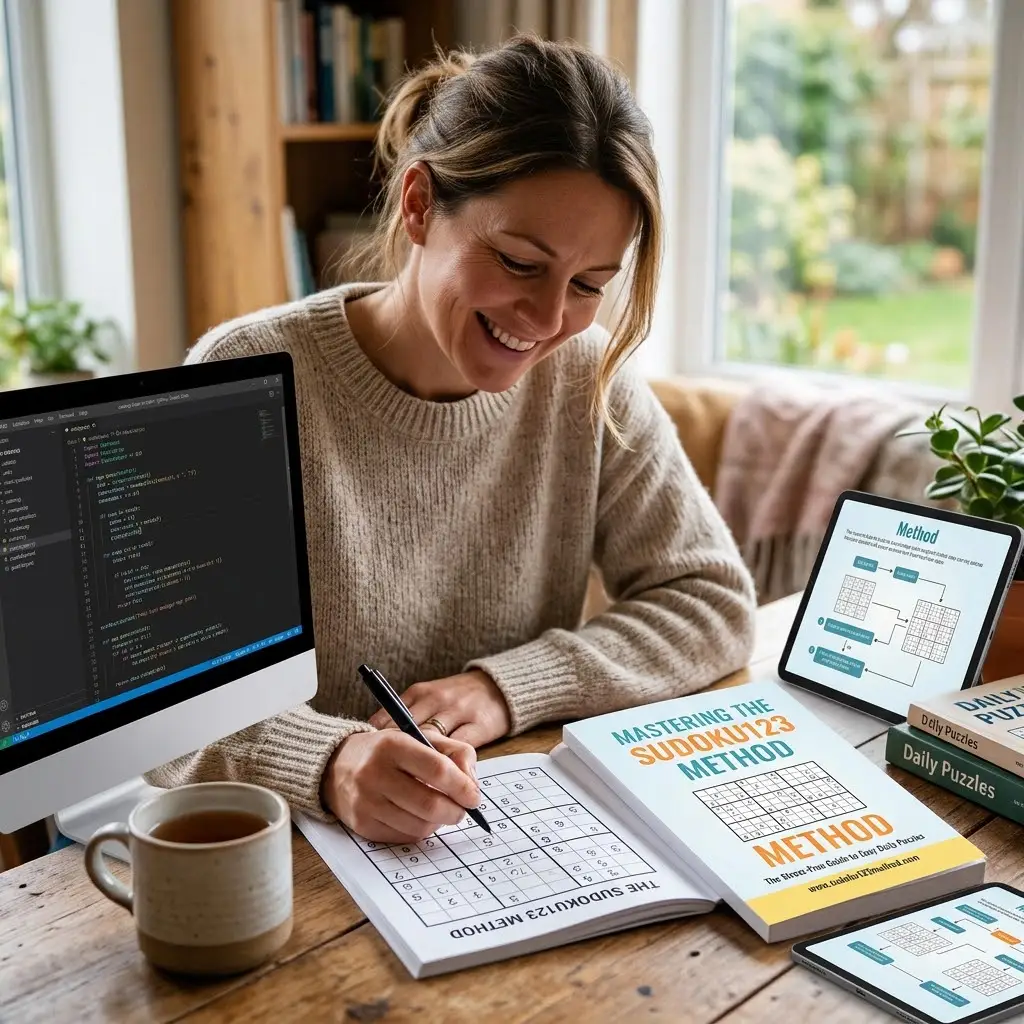
What is the Sudoku123 Method?
If you have ever opened a Sudoku grid only to feel overwhelmed by complex number combinations and visual clutter, you are not alone. The Sudoku123 method was designed to eliminate the frustration of standard puzzle solving.
Unlike traditional methods that demand intense mental arithmetic or multi-step logical deductions, the Sudoku123 technique turns grid solving into a calm, stress-free daily puzzle routine. By focusing on simple pattern identification and limited candidate positioning—often working with just 1, 2, or 3 candidate numbers or pencil notes at a time—it transforms how you approach the board.
Why “No Logic” Means Stress-Free Puzzling
The online puzzle games for seniors
When people hear “logic puzzle”, they often picture frustrating trial-and-error, mental multi-tracking, and headache-inducing guesswork. The Sudoku123 method strips away these complex logical hurdles:
Pure Visual Scanning Over Calculation: You aren’t calculating probabilities or holding complex visual trees in your mind. You are simply scanning rows, columns, and 3×3 boxes for clear visual openings.
Reduced Mental Load: By restricting your notes and focus to clear, immediate placements, you avoid a cluttered board and eliminate eye strain.
A Calming Daily Workout: Removing hyper-complex logic turns a Sudoku puzzle into a meditative daily brain exercise rather than an exhausting test. It provides gentle cognitive stimulation while keeping your mind relaxed and focused.
Why using the sudoku123 method on Easy Puzzles Is Perfect for Beginners
For newcomers, standard classic Sudoku can feel intimidating. The Sudoku123 approach and YouTube demonstration serves as the ideal entry point on easy and some moderate grids for several reasons:
Immediate Success: Easy puzzles feature an abundance of starting numbers (given digits), giving you frequent visual cues that make single placements obvious.
Confidence Building: Learning the fundamental rhythm—scanning using the 1,2,3, method, will complete puzzles smoothly using random scanning without getting stuck or making clutter and messy errors.
Establishing Habitual Routines: Starting with easier grids builds core visual fluency, training your eye to spot open cells quickly while keeping the experience enjoyable.
Setting Up Harder Grids:
The Initial Layout and the “Whirlpool” Effect
While the method shines brightly on easy and medium boards, it also serves as a powerful foundational setup tool for harder grids.
Before diving into complex logical deductions, applying the 1-2-3 routine randomly quickly sweeps across the entire grid to place every direct, obvious digit without overloading the board with a chaos of speculative pencil marks. As you systematically scan and place numbers, a unique phenomenon occurs—the whirlpool effect:
Inward Acceleration: Placing a digit in one box creates a ripple across adjoining rows and intersecting columns, pulling adjacent empty cells into focus like a funnel.
Flushing Out Clutter: Just as a whirlpool draws debris down its centre, this rapid sequence flushes out impossible candidate positions across neighbouring boxes.
Uncovering Hidden Singles: What initially appeared to be a dead end on a hard grid breaks open—revealing clear “sole candidates” and simple single placements that were previously hidden under the surrounding noise of too many pencil notes.
Organising Remaining Pencil Notes for Advanced Tactics
Eventually, even after the whirlpool effect has cleared away maximum clutter, a hard puzzle will reach a natural standstill where pure visual scanning hits a wall. This is where the organisation of your remaining pencil notes becomes invaluable:
Structured Candidate Clusters: Because you kept pencil notes tightly organised—focusing on pairs and triples rather than marking every possible candidate—the remaining empty cells form a clean, structured map.
Instant Pattern Recognition: Cleanly grouped pencil notes allow your eyes to immediately identify advanced structural formations—such as hidden/naked singles, hidden/naked pairs, Pointing Triples, or XY-Chains—without having to wade through a sea of messy, unnecessary numbers.
Seamless Handoff: The Sudoku123 method doesn’t try to force a simple tool onto an expert puzzle; instead, it leaves behind an impeccably organised grid, giving you the perfect launching pad to execute advanced logical tactics quickly and without error.
Summary Checklist: Is the Sudoku123 Method Right for You?
Yes, if you want a relaxing, visual daily brain exercise without stress or complex arithmetic.
Yes, if you are a beginner or senior looking for an accessible, structured way to enjoy easy Sudoku grids.
For Hard Grids: Treat Sudoku123 as your starting routine—clearing initial clutter via the whirlpool effect and leaving behind organised notes—before applying advanced solving techniques.
Advanced technique.
Shake down:
Visually split the puzzle into groups of three horizontal and three vertical squares. Error-check each group of three and remove unwanted pencil notes.
Frequently Asked Questions (FAQ)
What is the Sudoku123 method?
The Sudoku123 method is a calm, pattern-based approach to solving Sudoku puzzles without complex mental arithmetic or stressful logic trees. It focuses on visual scanning and restricting candidate pencil notes to small, manageable groupings.
Is the Sudoku123 method good for beginners?
Yes! It serves as an ideal entry point for beginners because it provides immediate success on easy puzzles, builds core visual scanning fluency, and helps establish a stress-free daily puzzling routine.
Can the Sudoku123 method solve Hard or Expert Sudoku puzzles?
The Sudoku123 method reliably solves Easy and many Medium puzzles on its own. On Hard or Expert puzzles, it clears initial clutter through the “whirlpool effect” and leaves behind organised pencil notes, providing a clean setup before advanced solving techniques are required.
What is the “whirlpool effect” in Sudoku?
The whirlpool effect occurs when systematic random scanning and placing direct digits cause a cascading chain reaction across intersecting rows, columns, and 3×3 boxes. This process flushes out clutter and uncovers hidden single placements naturally.
Does playing Sudoku require high-level math skills?
No. Classic Sudoku uses numbers purely as visual symbols. The Sudoku123 method relies strictly on visual pattern recognition rather than arithmetic or math calculations. Perfect for brain exercise.
Check out our free website or our BLOG for further information.