
A blank Sudoku square can feel like a roadblock when you are new to the puzzle. Pencil notes change that feeling. Instead of trying to hold every possibility in your head, you place a small reminder in the square and move on calmly.
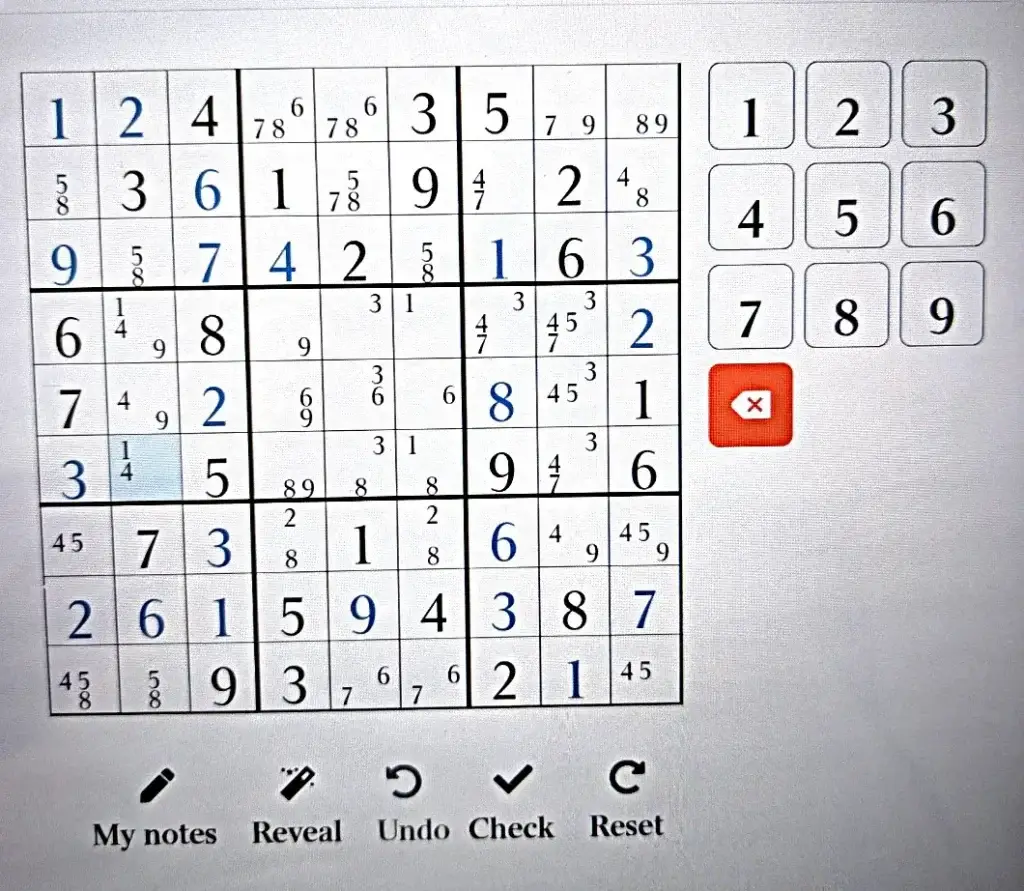
Look carefully at the image above. Using the reduced pencil marks routine on this very difficult puzzle has removed the clutter and left the puzzle open to careful observation. At the time of this photo, little attention had been paid to the centre square because it was without any clues.
Once the pencil mark routine is mastered, solving the very hard puzzles becomes a lot easier.
Practice the reduced pencil mark routine at least 30 times on an easy puzzle before considering upgrading to a harder one.
For many people, especially those who have been put off by traditional Sudoku lessons, this is a welcome change. You do not need math. You do not need to race through numbers in order. You do not need to memorise complicated logic rules. You need a simple routine, an easy puzzle, and permission to take one square at a time.
What Are Pencil Notes in Sudoku?
Pencil notes are small candidate numbers written inside an empty square. They show which numbers could still belong there based on the Sudoku rules: each row, column, and 3-by-3 box must contain the numbers 1 through 9 once each.
Think of a pencil note as a gentle prompt, not an answer. It says, “This square may be one of these numbers. I can return to it later.” That removes the pressure to solve everything immediately.
At Sudoku123, pencil notes are kept deliberately simple. A square should have only two possible numbers or three possible numbers before you make a note. If four, five, or more numbers seem possible, leave the square alone for now and continue scanning elsewhere. This keeps the page clear and prevents notes from becoming another source of confusion. Important
Why Fewer Pencil Notes Can Be More Helpful
Some Sudoku methods encourage players to fill nearly every blank square with tiny numbers. Although that may suit experienced puzzle solvers, it often makes an easy puzzle look crowded and intimidating. A page full of miniature writing can take attention away from the simple information that matters most.
Limiting pencil notes to two-cell and three-cell possibilities gives your eyes less to sort through. You are not trying to create a detailed map of every option. You are simply noticing the squares that are nearly ready.
Without the clutter of additional pencil marks, a placement of a correct number becomes obvious.
This approach also supports a calmer solving rhythm. Scan the puzzle, find a clear placement, write it in, and then look again. Each completed number changes the row, column, and box around it. A square that had three possibilities may soon have only one. That is often when the next answer becomes easy to see. Each correct placement means you can discard and delete all the pencil marks in the square, row and column attached.
The puzzle will wait for you – just keep the ripples moving!
There is a trade-off, and it is a useful one. You may leave more blank spaces than a conventional solver would, but your notes stay meaningful. For beginners and returning players, clarity is usually more valuable than filling the grid with information.
With less clutter, you will notice a pair, and possibly a single or hidden single.
How to Make Pencil Notes Without Overthinking
Start with an easy standard Sudoku puzzle. Look at any empty square and check its row, column, and 3-by-3 box. Which numbers are already present? The missing numbers are the only possibilities for that square.
If just two numbers remain possible, write both as small pencil notes. If three numbers remain possible, write those three. If more than three remain, do not force it. Move to another part of the puzzle.
There is no prize for making the smallest or neatest notes. If you are using paper, make them large enough to read comfortably. If you are solving digitally, use the note feature only when it helps you pause and see the choices. Comfortable visibility matters more than speed.
Keep Notes in a Consistent Position
A simple placement routine can make notes easier to follow. Put each candidate in roughly the same spot within a square every time. For instance, you might place smaller numbers towards the upper area and larger numbers lower down, or simply arrange them in a way that feels natural to you.
The exact position is not a rule you need to memorise. Consistency is the helpful part. When your eyes return to the grid, they will recognise your pattern more easily. If a note is no longer possible, erase it or remove it straight away so the puzzle stays clean.
Use Random Scanning, Not Number Order
Many players were taught to work through Sudoku by checking number 1 everywhere, then number 2, then number 3. This is entirely wrong and misleading.
A random scanning routine is different. Let your eyes move naturally around the grid. Notice a row, column, box, or square that looks promising. Perhaps it has only a few blanks. Perhaps you spot a number that appears often nearby. Start where your attention lands.
This is not careless solving. You still check the same three places: the row, the column, and the box. You are simply free to choose where to look next. That freedom can make the process feel less like schoolwork and more like a quiet, engaging activity.
When you find a square with two or three possibilities, add pencil notes, but never more than two or three. Then continue scanning. You do not need to sit and stare until the answer appears. Often, another clear placement elsewhere will provide the information you need.
A Calm Routine for Working With Notes
Pencil notes work best when they are part of a repeatable routine rather than a rescue tool used only when you feel stuck. Begin by looking for an obvious number that can be placed immediately. This may be a square with only one possible number, or a number that has only one suitable position in a row, column, or box.
Visually combine three squares vertically or horizontally, and check your placements.
After placing that number, take a fresh look around the area it affects. Check whether any nearby pencil notes can be removed. A two-number note may become a single answer. A three-number note may shrink to two and become more useful.
Then let your eyes travel to another area of the puzzle. This small change of focus is valuable. It gives your mind a chance to notice patterns without pressure. If nothing is clear, make one or two careful notes and move on again.
Avoid guessing. Guessing can turn a peaceful puzzle into a frustrating correction exercise. On an easy Sudoku, patient scanning and simple notes are enough to keep the puzzle moving forward.
Make Pencil Notes Part of a Daily Puzzle Habit
Over time, you may notice that you recognise possible placements more quickly. The satisfaction comes from seeing a structured task become manageable, one clear square at a time.
This is the mental exercise that you needed. Raised awareness comes with quality exercise, not force. That moment when you take your eyes off the piano keys is priceless!
Sudoku is recreational mental activity, not medical treatment or a replacement for professional health advice. Still, a calm routine that asks you to observe, focus, and make small decisions can be a rewarding part of general well-being.
Start with one easy puzzle and one useful note. A square with two possibilities is not a problem waiting to defeat you. It is simply the next small step towards a finished grid.
Check out our free website or our BLOG PAGES for further information.