
A Sudoku puzzle can either feel like a quiet cup of tea or a test you did not ask to take. The difference is rarely the 9×9 grid itself. Any worthwhile endeavour requires attention to detail, accuracy, and commitment.
Mistakes will occur, particularly when you are learning.
The Sudoku123 method, carefully used, will always reduce errors. However, it goes without saying that a number placed on the wrong row or column can, if not detected, cause a problem.
It is particularly useful to develop a routine to find and correct errors. It is far too late to discover that the puzzle is not resolving itself, or that the number destined for the selected cell obviously cannot go there.
The purpose of completing the puzzle is to produce a result. There is only one answer to each puzzle. Your mission is to fill all the cells with the original puzzle numbers for that puzzle. The brain exercise results partly from the pleasure of the result.
Many benefits flow from this successful conclusion: increased clarity, cognitive reserve and neuroplasticity, focus and patience. For many, a significant memory enhancement.
What Makes a Sudoku Experience Feel Calm?
This style of Sudoku is especially well suited to the person who has said, “I am not good at puzzles,” or “I was never good at math.” It is also a good fit for someone returning to puzzles after many years and finding that old methods feel confusing or slow.
Adults in retirement, people enjoying quieter mornings, and anyone seeking a gentle activity between appointments may appreciate the structure. A single easy puzzle gives the day a small, meaningful shape. There is a beginning, a sequence of observations, and a visible finish. Completing it can bring the same grounded feeling as finishing a familiar crossword clue, tending a plant, or practising a few lines of music.
For many people, traditional Sudoku teaching starts in the wrong place. It can sound mathematical, full of rules, and aimed at people who already know how to spot complicated patterns. That is enough to make a capable person put down the pencil before placing a single number. A calmer approach removes that barrier. It asks you to observe what is already on the page and follow a small routine. Sudoku does not require arithmetic, advanced math, or special powers of logic. It asks you to observe what is already on the page and follow a small routine.
An effective and simple error checking method
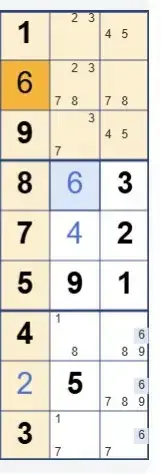
Look at the picture above. Here is a single vertical stack (or tower) of three 3 x 3 boxes from a standard 9 x 9 Sudoku puzzle. Because space is limited on this blog layout, the other two vertical stacks to the left have been removed. Your focus must be entirely on error checking this vertical stack. (Always reference the influencing completed numbers that, in this case, are to the left.)
An easy routine of error checking requires that you check all nine numbers in sequence, one through nine, examining both the pencil notes and the resolved numbers. You are not scanning randomly at this point; you are carefully error-checking your work.
When conducting your sequential check over the vertical stack, pay close attention to how cells interact. Spotting pairs to clear notes: Look at the top 3×3 box. In the right-hand column (Rows 1 and 3), notice the 4, 5, pair pencil notes. Checking across to the left in those rows confirms how these numbers are restricted. Once a pair like 4 and 5 is locked in, any extra pencil notes in those two cells can be safely removed, decluttering the grid immediately.
Tracing numbers across boxes: Look at the digit 6. It is resolved in Column 1 of the top box (highlighted in orange) and in Column 2 of the middle box (blue 6). This restricts 6 in the bottom box to Column 3, where pencil notes are written in blue.
Important: Remove any unwanted pencil notes as you go, and keep your focus strictly on one number at a time.
The Value of a Simple 1-2-3 Routine
An easy Sudoku is not a medical treatment, and it should never be presented as one. It cannot diagnose, prevent, or cure memory loss, dementia, or any health condition. For personal health concerns, a qualified health professional is the right source of advice.
Still, many people value mentally engaging activities as part of general well-being. A quiet puzzle session can invite concentration, observation, and patience. It gives the mind one manageable thing to do, which can be especially welcome when the day feels busy or scattered.
The Sudoku123 method, importantly, reduces the number of pencil notes, many times leaving a vacant cell. This removes the clutter. Error checking further reduces the chance of an annoying mistake that spoils the pleasure of the exercise.
Easy puzzles also allow you to practice without the discouragement of repeated dead ends. You are building familiarity with rows, columns, boxes, and the visual layout of the grid. With regular use, you may notice that you settle into the task more quickly. That is not a promise of a medical outcome. It is the ordinary confidence that grows when you repeat a skill.
Think of it like learning a simple piece on the piano. The first attempt may involve stopping and looking carefully at each note. After a few sessions, the hands and eyes recognise more of the pattern. The reward is not only the final performance. It is the enjoyable act of becoming more comfortable along the way.
Check out our Free Web-Site or our BLOG PAGES for further information.