
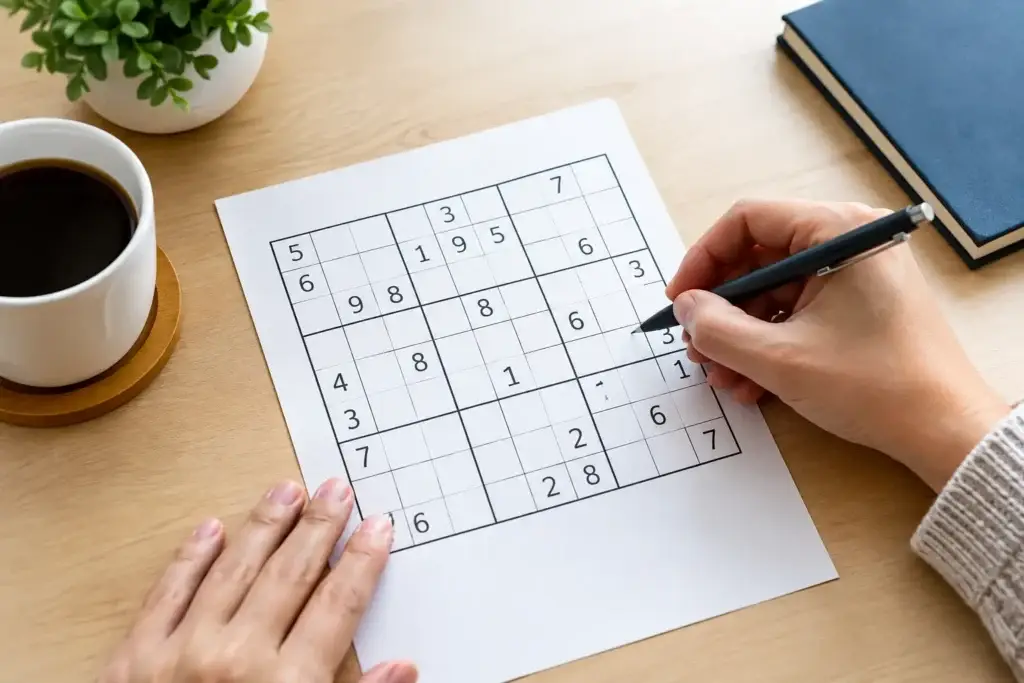
A Sudoku grid can look like a page full of numbers waiting to test your math skills. It is not. Sudoku without maths explained in the simplest way is this: the numbers are labels, not sums. You never add them, subtract them, multiply them, or calculate anything. You simply notice which label is missing from a small part of the puzzle and place it where it belongs.
That is good news if you have avoided Sudoku because school math was not your favorite subject, or because other Sudoku instructions felt like a test. A classic 9-by-9 Sudoku is a calm observation puzzle. With a simple routine, an easy puzzle can become a satisfying daily brain exercise rather than an intimidating challenge.
What Sudoku Actually Asks You to Do
A Sudoku grid has nine rows across, nine columns down, and nine smaller 3-by-3 boxes. Your task is to place the numbers 1 through 9 so that each number appears once in every row, once in every column, and once in every box.
Those are the only rules. The puzzle does not ask whether 4 plus 5 equals 9. It does not reward fast arithmetic. The number 7 could just as easily be a letter, a color, or nine different symbols. Numbers are used because most people recognize them quickly.
Think of a row with eight numbers already filled in: 1, 2, 3, 4, 5, 6, 8, and 9. The missing number is 7. That is not a calculation. It is simply noticing what is absent. Then you check that the empty square is also suitable for 7 in its column and 3-by-3 box. When all three areas agree, you can write in 7 with confidence.
Sudoku Without Maths Explained: The 1-2-3 Routine
The most comfortable way to begin is to let go of old habits. Many traditional methods tell players to work through every number in order, repeatedly checking all the 1s, then all the 2s, and so on. That can feel repetitive and tiring, especially for a beginner.
The Sudoku123 approach uses a gentler random scanning routine. Rather than forcing yourself through a strict sequence, look at the grid and begin where your eye naturally lands. Find a row, column, or box that already has plenty of numbers. It may be close to giving you an answer. This keeps the puzzle moving and makes each small success easier to spot.
The 1-2-3 routine is built around three simple actions: scan, place clear answers, and make small pencil notes when needed. You do not need to memorize a long list of advanced patterns. You return to these same actions throughout an easy puzzle.
1. Scan for the Nearly Finished Area
Start by looking for a row, column, or 3-by-3 box with only one or two empty squares. Ask yourself, “Which numbers are missing here?” Then look at the matching columns or rows to see where each missing number can go.
For example, a box may be missing 2 and 6. One empty square sits in a column that already contains a 2. That square cannot be 2, so it must be 6. The other square becomes 2. This is observation, not math.
There is no need to scan in a particular order. You might notice a useful box first, then a column, then a row. Follow what is visible. If an area does not give you an answer quickly, leave it and scan somewhere else. Coming back later with fresh information often makes the answer obvious.
2. Place the Clear Single Answer
When only one number can fit in a square, write it in. This is often called a sole candidate, but the name is less important than the habit. You are looking for a square where the row, column, and box have ruled out every other number.
Take your time with each placement. Before writing a number, make a quick three-part check: Is it missing from the row? Is it missing from the column? Is it missing from the box? If the answer is yes to all three, it belongs there.
Each correct number gives the puzzle a little more structure. A row that was difficult may now have only one gap. A box that had several possibilities may now show a clear answer. This is why Sudoku feels rewarding when approached one small placement at a time. You are not trying to see the whole puzzle at once.
3. Use Pencil Notes Sparingly
Sometimes no square has an immediate answer. That is normal. Instead of guessing, make a small pencil note in an empty square to record the two or three numbers that could possibly fit there.
Keep these notes limited to two-cell and three-cell possibilities. If a square seems to have many possible numbers, move on and scan another part of the grid. Easy Sudoku puzzles are meant to reveal useful information gradually. Filling every empty square with a crowd of tiny numbers can make the page feel busy and take away the calm of the routine.
As you place more clear answers, return to your notes. A number may be removed because it has appeared in the same row, column, or box. When only one possibility remains, you have your next placement. Pencil notes are not a sign that you are stuck. They are a simple way to hold a small piece of information while the rest of the puzzle develops.
Why Random Scanning Can Feel Easier
A strict solving order can make Sudoku feel like work. You may spend several minutes searching for one particular number without finding anything useful. Random scanning gives you permission to change direction.
Look for what is easiest to see, not what a rulebook says you must inspect next. One person may spot nearly complete boxes first. Another may find columns easier to read. Both approaches are fine because the puzzle rules remain the same.
This flexibility is especially helpful if you are returning to puzzles after a long break. You do not need special powers of logic, quick reactions, or a competitive mindset. You only need to notice what is present, what is missing, and what is no longer possible.
A Calm Daily Puzzle Habit
An easy Sudoku can fit nicely into a quiet part of the day: with morning coffee, after lunch, during a break, or while settling down in the evening. Give yourself permission to stop after a few minutes and continue later. The value is in regular, enjoyable engagement, not in racing to finish.
Many people find that a familiar puzzle routine supports a feeling of focus and accomplishment. It can be a pleasant way to practice attention, observation, and patience. However, Sudoku is a recreational activity, not medical treatment or a substitute for professional health advice.
Choose easy standard puzzles while you learn. Completing an approachable puzzle builds confidence far better than struggling through a difficult one. Like learning a short piece of music on the piano, the reward comes from seeing a pattern become clearer through steady practice.
When You Feel Stuck
A pause is part of solving. If the grid starts to feel crowded, do not guess and do not push harder. Put the pencil down for a moment, then return to a different row, column, or box. Check whether a number you recently placed has created a new single answer elsewhere. The Whirlpool Effect.
The Sudoku123 solving method takes advantage of a scientifically noted effect. A correct number placed in a cell ripples across the whole puzzle. Random scanning takes account of this phenomenon and greatly assists solving a Sudoku puzzle.
It also helps to keep your process simple. Scan the easier-looking areas, place what is certain, and use only small notes for two or three possibilities. You do not have to understand advanced Sudoku language to enjoy an easy puzzle. The three basic rules and the repeatable 1-2-3 routine are enough to get started.
Free access to a clear introductory video, a short demonstration, and an easy completed-puzzle example can make the first few attempts feel much more comfortable. Sudoku123 was created to help beginners build that confidence without turning Sudoku into a maths lesson.
Your next puzzle does not need to be harder than the last one. Choose an easy grid, begin with the area that catches your eye, and let one clear number lead naturally to the next.