
A Help-solve-pairs approach can make Sudoku feel far less mysterious. It is not about advanced math, racing the clock, or memorising complicated logic. It is simply a gentle way to notice when two empty squares may be working together – and to use that observation as part of a calm, repeatable puzzle routine.
For many people, traditional Sudoku lessons become confusing because they introduce too many techniques at once. At Sudoku123, the aim is different: begin with an easy standard puzzle, use a fresh random scanning routine, and allow simple observations to build confidence. You do not need previous Sudoku experience. In fact, setting aside old solving habits can make learning the 1-2-3 method easier. Important.
What does Help-solve-pairs mean in Sudoku?
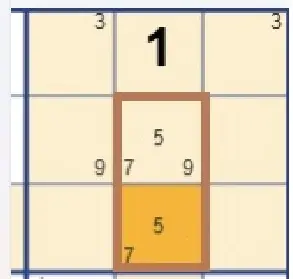
A pair is a small pencil-note pattern. You may find two empty cells in the same row, column, or 3-by-3 box that can each accept the same two possible numbers. Those two cells form a pair.
Look at the picture above. The seven and the five are confirmed as a pair. This means that the nine cannot be included in that cell. Remove it and (in this case) confirm the nine in its correct cell. When continuing your random scan, ensure that no other pencil marks occupy those two cells, they are reserved for either the seven or the five.
You do not need to know which one goes where yet. The useful part is recognising that those numbers are already reserved for those two squares.
This can help you look at the remaining empty squares in that row with clearer eyes. If another square had a pencilled 5 or 7 among its possibilities, you can remove that option, because the pair has claimed it.
When it comes to error checking, there are fewer pencil marks and more certainty of the surrounding numbers.
That may sound technical when written down, but it becomes much friendlier when you see it on an easy puzzle. Think of it as tidying a small corner of the grid, not solving the whole puzzle at once.
Why pairs can be helpful – and when to leave them alone
Pairs are useful when your normal scan does not immediately reveal a single answer. They can reduce a little uncertainty and sometimes create the next obvious placement. But they are not something to hunt for in every row, column, and box.
That is where Sudoku can become tiring. If you force yourself to search every possibility, the puzzle stops feeling like a pleasant mental exercise. The better choice is to use pairs only when they appear naturally during your regular scan.
With the Sudoku123.net routine, pencil notes are kept deliberately limited. Notes are used for two-cell and three-cell placements only, rather than filling every empty square with a crowded collection of tiny numbers. A cleaner puzzle is easier to see and easier to return to after a cup of tea or a short break.
A calm routine for spotting pairs
Start by checking the basic rule: each row, column, and 3-by-3 box needs the numbers 1 through 9, with no repeats. There is no calculation involved. You are simply looking for which number is missing and where it can go.
Look through the grid without following numbers in strict order. Notice an easy placement when it appears, fill it in, and let that new number affect the surrounding row, column, and box. Note; This random scanning method is critical. More information in the web pages at sudoku123.net
If you reach two nearby cells that each have the same two possible numbers, make a small pencil note. Do not add extra pencil notes “just in case.” Then continue scanning. Often, another placement elsewhere will settle one of the two cells naturally.
TIP. Once identified, place a small line under each pair number to remind you it is a pair.
A pair is a helpful pause point, not a demand for a difficult decision. If it does not lead to anything clear, move on. The next scan may reveal a sole candidate or an obvious unique place for a number. Sudoku rewards patience more than pressure.
Keep your pencil notes light
The purpose of pencil notes is to support your observation, not create a page of homework. Two possible numbers in a cell can be useful. Three possible numbers can also be useful. Beyond that, it is often better to keep scanning and wait for the grid to provide more information. The random method of scanning does this beautifully.
This lighter approach can be especially reassuring for returning players who have felt overwhelmed by traditional Sudoku methods. You are allowed to take your time. You are also allowed to leave a pattern alone until it becomes clearer. The puzzle will wait for you – just relax.
A small daily exercise for focus
An easy Sudoku puzzle can be a satisfying part of a daily routine, much like practicing a simple piece of music. The value is in showing up, noticing more over time, and enjoying the feeling of completing a structured task.
Sudoku is a recreational activity and not medical advice or a treatment for memory concerns. Still, many people enjoy it as a quiet way to practice attention, observation, and concentration during a break or a peaceful part of the day.
When a pair appears, do not see it as a test. See it as two little spaces asking for a bit of patient attention. Start with an easy puzzle, keep your notes simple, and let each clear placement encourage the next.
Check out our free website or our BLOG PAGES for further information.