
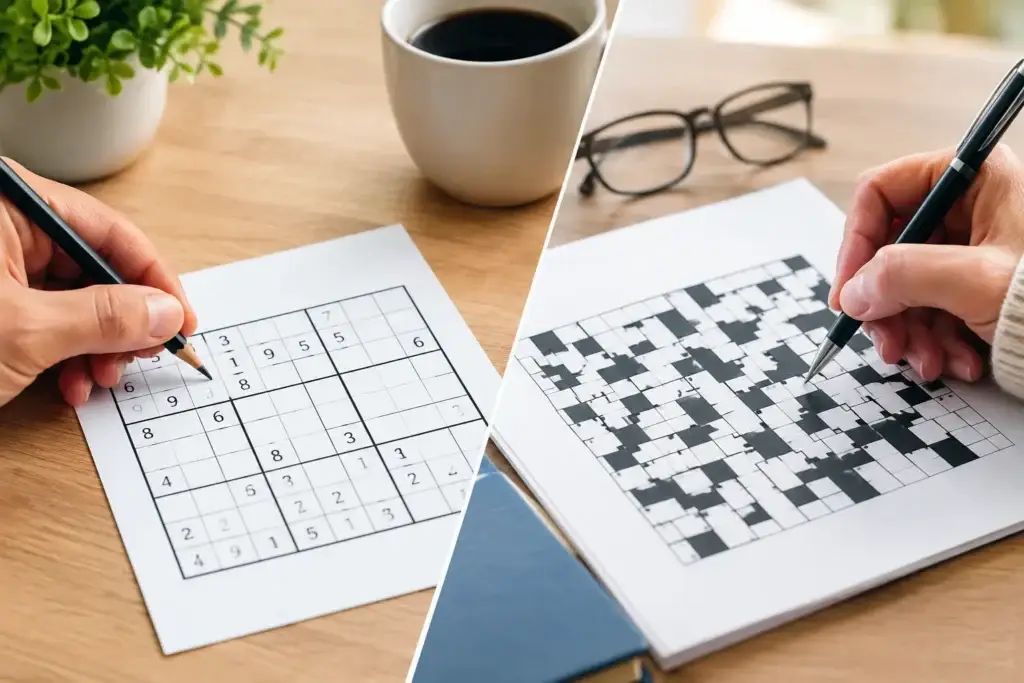
A quiet morning can feel very different depending on the puzzle in front of you. When considering sudoku vs crossword puzzles, the better choice is not the one that seems smarter or harder. It is the one you will genuinely enjoy returning to – without frustration, pressure, or the feeling that you should already know the answers.
Both can make a satisfying daily mental habit. Both ask you to focus, notice patterns, and stay with one small task at a time. But they use different kinds of thinking. A crossword leans on words, memory, and cultural knowledge. Sudoku uses observation and simple placement rules. For many beginners and returning puzzle players, that difference matters more than they expect.
Sudoku vs crossword puzzles: the real difference
Crossword puzzles ask, “What do I know?” A clue may call on vocabulary, spelling, history, geography, entertainment, or a particular style of wordplay. That can be delightful when the clues match your interests. It can also be discouraging when a puzzle seems built around names, expressions, or references you have never encountered.
Sudoku asks a different question: “What can I see?” The digits are labels, not math problems. You never add, subtract, multiply, or need to be good with numbers. In a classic 9-by-9 Sudoku, each row, column, and 3-by-3 box must contain the numbers 1 through 9 once. The task is simply to place each number where it belongs.
That makes Sudoku especially welcoming for people who say, “I am not a math person,” or who have been put off by difficult puzzle instructions in the past. It is not about quick calculations or special powers of logic. It is about calmly observing what is already on the page.
Crosswords can feel like a conversation with a clever editor. Sudoku can feel more like putting a room in order: there is a clear place for each piece, and progress becomes visible one small step at a time.
Choose the puzzle that removes the most barriers
The best daily brain exercise is often the one with the fewest reasons to avoid it. If you enjoy language, clues, and the occasional “Oh, of course!” moment when a word comes back to you, a crossword may be a wonderful fit. It can bring back memories, introduce new words, and offer a satisfying connection to topics you enjoy.
But crosswords have a hidden barrier: background knowledge. A clue about an old television show, a sports statistic, a foreign phrase, or a current celebrity may stop the whole puzzle. Some people enjoy looking up the answer. Others feel that the interruption breaks their concentration.
Sudoku has fewer of these outside demands. The rules stay the same from puzzle to puzzle. Once you understand rows, columns, and boxes, you do not need to know a person, place, quotation, or unusual spelling to move forward. An easy puzzle can offer a reliable routine, even on days when you do not feel especially sharp or talkative.
This does not make one puzzle superior. It simply means they support different moods. A crossword may suit an alert, curious afternoon with a cup of coffee and a newspaper nearby. An easy Sudoku may suit a quieter moment when you want a clear task and a calm finish.
What each puzzle asks your mind to do
A crossword begins with clues. You read, recall, make associations, test possible words, and use crossing letters to correct yourself. It rewards flexible language skills and persistence. Even when you do not know an answer right away, a few letters can trigger recognition.
Sudoku begins with the grid. You look for what is missing in a row, column, or box. You compare what you see, narrow the possibilities, and place a number when it is the only one that fits. The work is visual and orderly. There is no need to hold a long clue in your head or search your memory for a word from decades ago.
For some people, the lack of verbal demand is a relief. They may spend much of the day reading, talking, remembering names, or making decisions. Sudoku offers a break from language while still giving the mind something purposeful to do.
For others, words are exactly what make a puzzle enjoyable. A crossword can feel social, even when solved alone, because it draws on shared language and familiar references. A couple may enjoy discussing clues together in a way that is less natural with a Sudoku grid.
The choice depends on what leaves you feeling refreshed rather than drained.
Why difficulty level matters more than puzzle type
A hard crossword and a hard Sudoku can both become frustrating. The common mistake is assuming that a difficult puzzle is automatically better exercise. It is not. If a puzzle creates tension, confusion, or a sense of defeat, it may be less likely to become a helpful regular habit.
An easy standard puzzle has real value. Completing it gives you a beginning, middle, and end. You practise attention, observation, and follow-through, then enjoy the quiet satisfaction of seeing the page completed. That feeling can be motivating enough to return tomorrow.
With crosswords, choosing an easier puzzle may mean shorter clues, more familiar vocabulary, and fewer tricks. With Sudoku, it may mean more starting numbers and clearer opportunities to spot where a digit belongs. Neither choice is “cheating.” It is choosing a level that supports confidence.
Exercise to most people means improvement. That extra push-up, an extra few minutes on the bike, more weight on the equipment. It is not unreasonable; – you are human to want to extend yourself. Yes, there is a pathway to this reasonable objective. However, with Sudoku, brain training differs from muscle training in the same way that learning to play a musical instrument does.
On the web page, Sudoku123.net reference is made to solving harder puzzles. The main requirement centres around the need to solve at least 30 easy puzzles confidently. If you choose to join as a member, there are many tips & tricks that you can learn that will solve even a diabolical sudoku puzzle.
A gentle way to begin Sudoku
Traditional Sudoku advice can make the game seem far more complicated than it needs to be. Long lists of techniques, advanced patterns, and sequential number-checking routines can overwhelm a beginner before they have completed a single box. The “123” method prepares your brain for harder puzzles.
A simpler approach starts with an easy puzzle and a repeatable routine. At Sudoku123, the 1-2-3 method uses random scanning rather than checking numbers in a fixed order. You look around the grid, notice an opportunity, and make one clear placement at a time. Pencil notes are kept limited to two-cell and three-cell placements, helping the page remain readable rather than crowded.
The point is not to race. It is to develop a familiar rhythm. Look at a row, column, or box. Notice what is missing. Check where a number can go. Write it in when there is one clear choice. Then move on.
A short guided demonstration can make this feel much more achievable than reading technical instructions. Many people find that a 15-minute easy-puzzle solve is enough to show that Sudoku does not require mathematics, complicated rules, or previous experience. It requires patience and a method you can repeat.
Can you do both?
Absolutely. There is no need to choose one puzzle forever. Some people like a crossword in the morning because words help them feel awake and engaged. Later, they may prefer Sudoku as a quieter activity that does not ask them to remember anything beyond the grid in front of them.
Doing both can also prevent routine from becoming stale. If one puzzle feels irritating on a particular day, switch without judgement. The goal is steady, enjoyable engagement, not proving anything.
You may also prefer one because of your surroundings. A crossword can be enjoyable with a partner, a family member, or a friend who likes to toss around possible answers. Sudoku can be ideal when you want independent quiet time, whether you are at the kitchen table, in a retirement community common room, or taking a peaceful break between errands.
Keep the purpose realistic and personal
Puzzles can be a positive part of a general wellbeing routine. They can give structure to quiet time, encourage focus, and provide the reward of finishing something small and meaningful. They are not, however, a medical treatment, a diagnosis tool, or a substitute for advice from a qualified health professional.
What matters most is the experience you create around the habit. Choose a comfortable place. Use good lighting. Start with an easy puzzle. Give yourself permission to stop and return later. If you make a mistake, erase it or begin again without turning it into a verdict on your ability.
A crossword may keep you connected to words you love. An easy Sudoku may show you that a calm, number-based puzzle can be approachable without any maths at all. Try the one that feels least intimidating today, and let tomorrow’s puzzle be a small appointment with your own attention.