
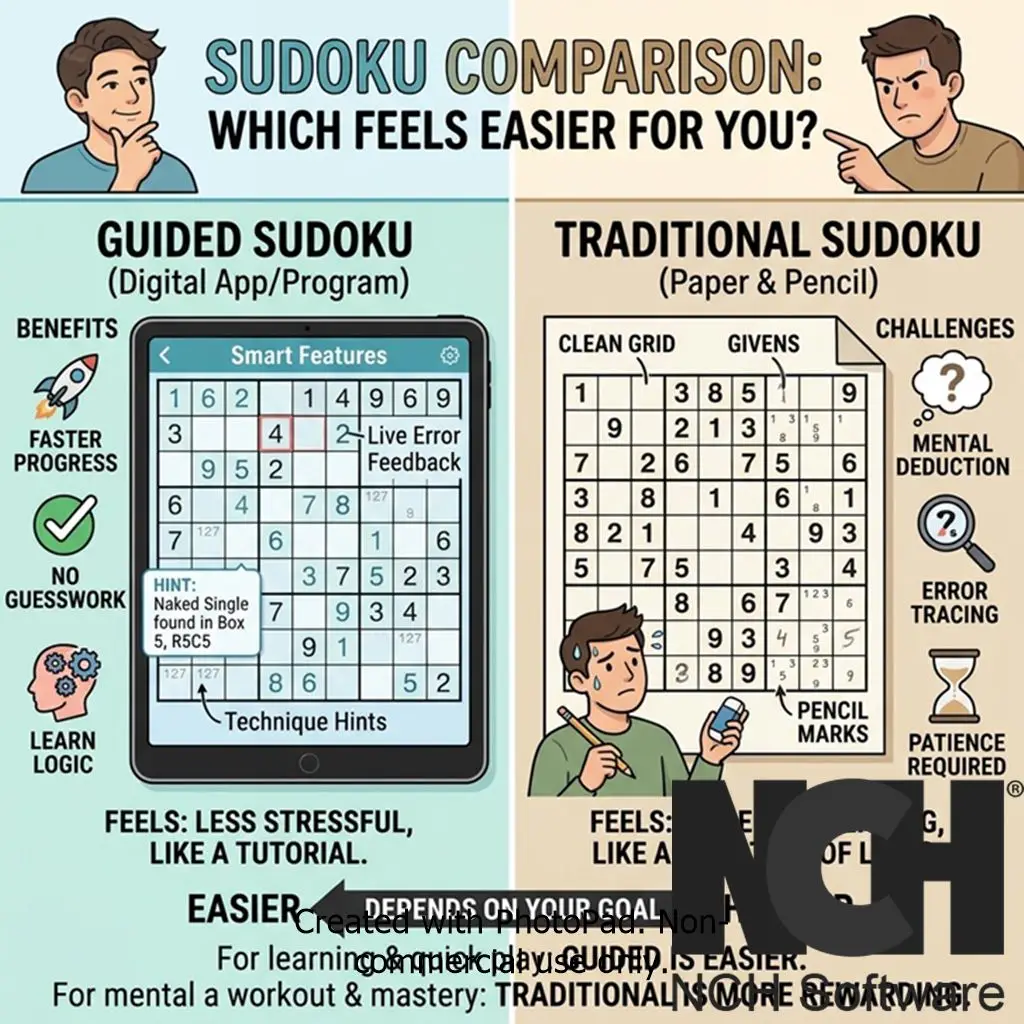
A blank Sudoku grid can make a perfectly capable person feel as though they have walked into a test without studying. That reaction is common, especially when past attempts involved confusing rules, pages of tiny notes, or the feeling that everyone else somehow sees the answer first. Guided Sudoku versus traditional Sudoku is not really a contest about which approach is smarter. It is a question of which experience helps you feel calm enough to begin – and pleased enough to continue.
For many adults, Sudoku is not about proving anything. It is a quiet moment with a cup of coffee, a welcome break from screens and errands, or a small daily task that brings a sense of order. The right method should support that feeling, not turn it into pressure.
What Traditional Sudoku Usually Asks You to Do
Traditional Sudoku teaching often starts with the same basic rule: each row, column, and 3-by-3 box must contain the numbers 1 through 9 without repeats. That is the whole puzzle. There is no arithmetic involved, even though the numbers can make it look like a math exercise.
From there, many traditional methods encourage players to check number 1 across the entire grid, then number 2, then number 3, and so on. When an obvious placement cannot be found, players may be taught to use increasingly detailed strategies, candidate lists, patterns, and names that can sound technical before a beginner has even finished one easy puzzle.
This approach works well for some people. If you enjoy studying systems, comparing possibilities, and tackling a challenge step by step, traditional Sudoku can be satisfying.
But it has trade-offs.
Sequentially checking every number can feel repetitive. Filling many tiny pencil notes can make the grid look crowded. (Paper or tablet)
And when a method is introduced as a test of logic, people who simply want a gentle mental activity may decide Sudoku is not for them.
That is unfortunate, because a standard easy Sudoku can be approachable. You do not need to be good at math. You do not need special powers of logic. You do not need to memorise a long collection of rules before you can enjoy placing a few numbers.
Guided Sudoku Versus Traditional Routines
Guided Sudoku takes a different starting point. Rather than asking you to follow a strict number-by-number sequence, it gives you a repeatable routine for looking around the puzzle. At Sudoku123, the 1-2-3 method uses random scanning rather than sequential number checking, along with three clear techniques that can be practiced on an easy standard puzzle.
Random scanning simply means you are not tied to starting with a particular number or searching in a fixed order. Your eyes can move naturally around the grid, noticing a row, column, or box where a placement is becoming clear. This can make the puzzle feel less like an exam and more like observation.
The guided routine also keeps pencil notes limited to useful two-cell and three-cell placements. That matters because notes should help you see, not cover the puzzle in clutter.
A page filled with possibilities may be appropriate for advanced solvers, but it can be discouraging for a newcomer who wants a clean, manageable activity.
A page full of pencil notes inevitably covers over important clues that can help solve the puzzle.
The aim is not to race through the grid or to impress anyone with a difficult technique. The aim is to repeat a few easy actions until they begin to feel familiar. Like learning a short piece of music on the piano, the satisfaction grows as your hands and eyes recognise what to do next.
A method can change the feeling of the puzzle
Traditional solving can put attention on finding the correct next strategy. Guided solving puts attention on following the next small routine. That may sound like a minor difference, but it changes the emotional experience.
When you are told to search for a rare pattern, it is easy to wonder whether you are doing it correctly. When you are shown where to look and what a simple placement looks like, you have something practical to try right away. A small success builds confidence. Confidence makes it easier to stay with the puzzle – frustration free!.
For adults returning to Sudoku after years away, this can be especially helpful. Previous habits do not always transfer well to a new routine. If you have been taught to scan numbers in strict order or fill every square with notes, give yourself permission to set those habits aside while you learn a guided approach. Starting fresh is often easier than trying to combine two different systems at once.
Who May Prefer Each Approach?
There is no need to declare one style best for every person. The better choice depends on what you want from your puzzle time.
Traditional Sudoku may suit you if you already enjoy advanced puzzles, like exploring detailed strategies, or want to work towards highly challenging grids. It can offer a deep hobby with plenty to learn. A difficult puzzle may be exactly what some experienced players are looking for.
Guided Sudoku may suit you if you are a complete beginner, feel intimidated by Sudoku, or want a regular brain exercise that does not take over your day. It is also a good fit if you prefer plain instructions, a slower pace, and the pleasure of completing an easy puzzle without feeling rushed.
For people in retirement, over 50, or looking for a calm activity during a quiet part of the day, the lower-pressure approach can be the more sustainable one. A puzzle habit only helps if it is a habit you want to keep. There is no prize for choosing the hardest grid in the newspaper if it leaves you frustrated enough to stop.
Easy puzzles are not a lesser choice
Many people assume they should move quickly from easy puzzles to hard ones. That belief can take the enjoyment out of Sudoku. An easy standard puzzle gives you room to practice scanning, strengthen observation, and experience the reward of finishing what you started. Just like learning to play a musical instrument.
Repeating an accessible routine can support focus and mental engagement as part of general well-being. It is not medical treatment, and no puzzle can promise to prevent or treat cognitive decline. Still, a simple daily activity that asks you to pay attention, make choices, and persist can be a positive part of a balanced routine.
Think of it as gentle exercise for your attention. You would not begin a walking habit by demanding a marathon on day one. You would choose a distance that feels possible, then return tomorrow. Sudoku can work the same way.
How to Try a Guided Routine Without Overthinking It
Begin with one easy 9-by-9 puzzle and allow yourself a few minutes without expectations. First, remember the simple structure: a number can appear only once in each row, column, and box. Then use the guided routine as it is taught, rather than switching back and forth between several methods. sudoku123 website
Let your eyes scan the grid naturally. When you find a clear placement, write it in. If an area needs notes, keep them small and purposeful, using only two-cell or three-cell possibilities. Then continue scanning. You are not trying to see the whole solution at once. You are looking for one sensible next move.
If you become stuck, that does not mean you have failed or that Sudoku is beyond you. Pause, look at a different box, or return after a short break. The puzzle will still be there.
There are three helpful videos.
- A brief introductory method video
- A short demonstration video,
- And with a fully worked, easy-puzzle-solve video, a guided method can make those first sessions feel much less lonely.
Make the Puzzle Part of Your Day
The greatest difference between guided Sudoku and traditional Sudoku may not be the technique itself. It may be whether the method invites you back tomorrow. A puzzle that leaves you settled, alert, and quietly satisfied has done something worthwhile.
Have you tried Sudoku and given up in frustration?
Choose an easy grid, give yourself permission to learn slowly, and notice the small moment when a number becomes clear. That moment is enough to begin building a routine your brain can look forward to.
Check out our free website or our BLOG for further information.