
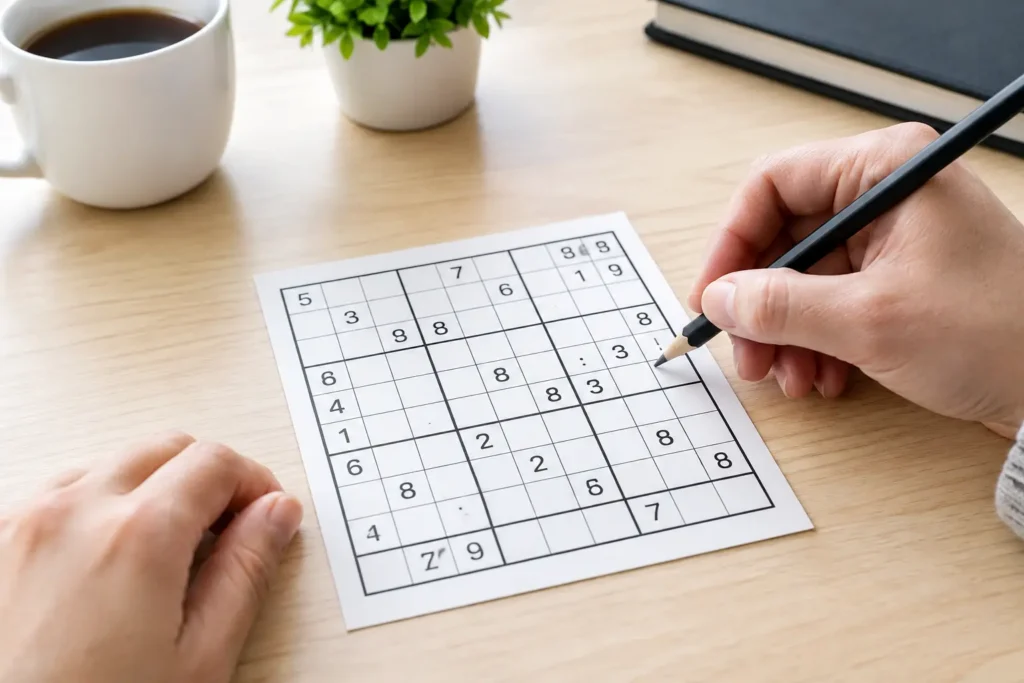
A Sudoku grid may look busy at first: 81 small squares, a few numbers already filled in, and plenty of blank spaces. But learning how to read a sudoku grid is much simpler than it appears. You do not need to do math, memorize complicated rules, or race against a clock. You only need to notice where numbers can and cannot go.
Think of the grid as a calm little sorting activity. Each number from 1 through 9 needs a place, and the puzzle gives you clues to help you find it. Once you know what you are looking at, the grid becomes far less intimidating.
How to Read a Sudoku Grid: Start With Its Three Parts
A classic Sudoku grid is a large square made up of nine smaller squares. It has nine rows going across, nine columns going down, and nine 3-by-3 boxes.
A row is a horizontal line of nine squares. A column is a vertical line of nine squares. A box is one of the nine smaller 3-by-3 sections marked by thicker border lines.
Every row, column, and box must contain the numbers 1 through 9 once each. That is the whole foundation of Sudoku. No number can appear twice in the same row, column, or box.
The numbers already printed in the puzzle are called given numbers or clues. They stay where they are. Your job is to use those clues to fill the empty squares, one sensible choice at a time.
There Is No Adding or Calculating
The use of numbers can make Sudoku seem like a math puzzle, especially if you have not played before. It is not. The number 7 does not have a larger value or special power over the number 2. You are not adding numbers together or working out equations.
You could replace the numbers with nine different symbols and the puzzle would work in exactly the same way. Sudoku is about noticing patterns, checking what is already present, and finding what is missing.
That makes it a welcoming activity for people who never enjoyed math at school. The skill grows through repetition, not through complicated calculations.
Read One Empty Square at a Time
When you first open a Sudoku, do not try to understand all 81 squares at once. Choose one empty square and look at the three groups it belongs to: its row, its column, and its box.
Ask a simple question: which numbers are already used here?
For example, imagine an empty square is in a row containing 1, 3, 4, 6, and 9. That means the row still needs 2, 5, 7, and 8. Next, look down that square’s column. If the column already contains 2 and 7, those two numbers cannot go in the empty square. Finally, check the 3-by-3 box. If the box already has an 8, the only possible answer is 5.
You have not guessed. You have simply read the information the grid provides.
At first, this process may feel slow. That is perfectly fine. A calm pace gives your eyes time to recognize the pattern. With practice, you will begin to spot missing numbers more quickly and naturally.
Use the Grid Like a Checklist
A useful way to approach Sudoku is to treat each row, column, and box like a checklist. The question is always the same: which numbers from 1 to 9 are missing?
Start with areas that already have many numbers filled in. A row with seven numbers has only two missing, which is often easier to read than a nearly empty row. The same is true for columns and boxes.
You might scan a box and see that it contains 1, 2, 3, 5, 6, 8, and 9. Only 4 and 7 are missing. Look at the two blank squares in that box. One may sit in a row that already contains 4, so it must be 7. The other square is then 4.
This is one of the gentlest ways to begin solving. You are narrowing down choices rather than trying to force an answer.
Notice a Sole Candidate
A sole candidate is an empty square that has only one possible number. This is often the easiest move to find.
To spot one, check the square’s row, column, and box. Cross off every number you can already see in those three places. If only one number remains, write it in with confidence.
For instance, if an empty square cannot be 1, 2, 3, 4, 6, 7, 8, or 9 because those numbers are already present in its row, column, or box, it must be 5.
Some puzzles offer several sole candidates early on. Filling in one can make another easier to see, because every new number gives the grid more useful information.
Look for the Only Place a Number Can Go
Sometimes an empty square has two or three possible numbers, so you cannot solve it yet. Instead of stopping, switch your attention from the square to the number.
Choose a number, such as 6, and look across one 3-by-3 box. Ask where 6 could possibly go. If the rows and columns around that box rule out 6 everywhere except one square, then 6 belongs there.
This is often called a unique candidate. It sounds technical, but the idea is straightforward: even if a square could hold more than one number, a particular number may have only one available home in that row, column, or box.
There is no need to learn advanced puzzle language before you begin. Simply remember the practical question: “Where can this number still fit?”
A Simple Reading Routine for Beginners
A regular routine can help Sudoku feel clear rather than overwhelming. Begin by scanning the 3-by-3 boxes, because their boundaries are easy to see. Look for boxes with just one, two, or three blank squares.
Then scan the rows, especially those that are nearly complete. After that, scan the columns. Each time you place a number, gently revisit the nearby row, column, and box. One answer often creates another opportunity.
If you cannot find a move right away, do not assume you are doing anything wrong. Put the puzzle down for a minute, look at a different box, or start a fresh scan from the top. Sudoku rewards patience. The answer may be visible once your eyes approach the grid from a new direction.
For beginners, it is usually better not to guess. A guess can make a later part of the puzzle confusing. Stay with choices you can explain: this number is missing, this column already has that number, or this box leaves only one place. Those small, certain steps build confidence.
Common Things That Make a Grid Harder to Read
The most common mistake is looking only at a row or only at a box. Every empty square belongs to all three groups, so always check its row, column, and box before entering a number.
Another challenge is trying to solve too much at once. Your attention does not need to cover the entire board. One square, one missing number, or one nearly complete box is enough.
It also helps to use a clear display. If you are playing digitally, make sure you can easily see the thicker lines around each 3-by-3 box. Those lines are useful visual guides, not decoration. On paper, you may find it helpful to lightly note possible numbers in a blank square, if that feels comfortable. Some players prefer notes; others prefer to keep the grid simple. It depends on what helps you feel focused.
Make Sudoku Part of a Calm Daily Habit
Reading a Sudoku grid is a small skill that becomes more familiar each time you practice. A few quiet minutes with a puzzle can provide a satisfying sense of order: scan, notice, place a number, and continue.
At Sudoku123, the goal is not to prove how fast you can solve a difficult puzzle. It is to give your mind a gentle, structured activity that supports focus and everyday mental engagement. Sudoku can be a helpful part of a general wellbeing routine, but it is not medical advice or a substitute for professional care.
Choose a beginner-friendly puzzle, give yourself permission to go slowly, and start with one box. The grid is not asking you to know everything at once. It is simply waiting for you to notice the next possible number.