
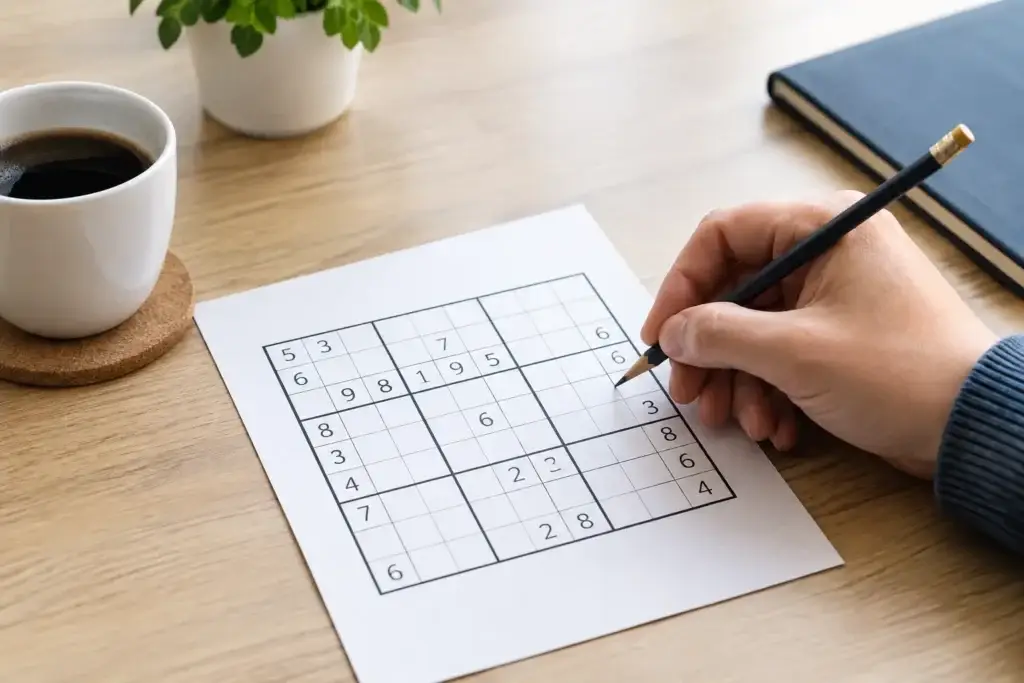
A blank Sudoku square can look more demanding than it really is. With three simple sudoku techniques, an easy 9×9 puzzle becomes a quiet, repeatable activity you can enjoy without math, complicated logic, or pressure to be quick. You are simply looking, noticing, and making one small decision at a time.
This is not about racing through a puzzle or proving how clever you are. It is a gentle exercise for attention and observation. If past Sudoku advice has left you checking numbers in strict order or filling every empty space with crowded notes, set that routine aside. The 1-2-3 approach is designed to feel clearer from the beginning.
First, remember the only three rules
Every Sudoku uses the numbers 1 through 9. Each horizontal row must contain each number once. Each vertical column must contain each number once. Each 3×3 box must also contain each number once.
That is all you need to know. There is no addition, subtraction, multiplication, or special mathematical ability involved. The numbers are simply symbols. If the puzzle used letters or colors instead, the idea would be exactly the same.
An easy standard puzzle is the best place to begin. It gives you enough clues to practice a steady routine without making the experience feel like a test. Keep your pencil nearby, settle into a comfortable chair, and allow yourself time. A completed puzzle is satisfying, but the calm attention you give it along the way matters too.
Technique 1: Scan randomly, not in number order
Many people are taught to start with the number 1, search the entire puzzle, then repeat with 2, 3, and so on. That can work, but it can also become tiring. It asks your eyes to travel through all 81 squares repeatedly, even when another part of the puzzle is ready to solve immediately.
Instead, let your eyes scan around naturally. Look at any row, column, or 3×3 box that catches your attention. You might notice a box with only two blank spaces. Or you may see a row that is missing just one number. Start there.
Ask one simple question: which numbers are missing here? Then check whether the row, column, and box allow one of those numbers in an empty square. When only one number can fit, write it in clearly.
For example, imagine a row is missing only 4. You do not need to look any further. The empty square must be 4. In another case, a box may be missing 2, 6, and 8, but the row and column around one square rule out 2 and 8. That square is 6.
After placing a number, scan again wherever you like. A new answer may now appear nearby, or somewhere completely different. This random scanning routine keeps the process fresh and helps you avoid the feeling of being trapped in a rigid system. There is no prize for following a particular path through the grid.
Let the puzzle show you where to look
A useful habit is to notice areas that are nearly complete. Rows, columns, and boxes with fewer blanks usually provide the clearest opportunities. If nothing stands out after a short look, move on without frustration. Another section may be easier to read, and a single number placed there can change everything. This is using the whirlpool effect to your best advantage.
This is one reason easy puzzles are so valuable. They allow you to build confidence in seeing what is already available rather than forcing an advanced strategy. Your job is not to force an answer. It is to notice the answer when the clues support it.
Technique 2: Use a two-cell pencil note
Sometimes you will find an empty square where two numbers could fit, but neither can be confirmed yet. This is the moment for a small pencil note, not a guess.
Write only the two possible numbers lightly in that square. Keep the note neat and small. For instance, if a square could be either 3 or 7, write 3 and 7 as your reminder. Then leave it alone and continue scanning elsewhere.
The note is not a problem to solve immediately. It is simply a bookmark for your eyes. As you fill more confirmed numbers into the puzzle, one of those two choices will often be ruled out naturally. When that happens, erase the note and enter the remaining number with confidence.
Keeping notes limited to two possibilities makes the grid easier to read. A square covered in many tiny numbers can become visually busy, especially when you return to it later. The 1-2-3 method favors calm, clear information over trying to record every possibility at once.
Never turn a pencil note into a guess
A two-cell note means, “I can wait.” That is a useful skill in Sudoku and in everyday life. If both numbers still fit, the puzzle has not given you enough information yet. Move to another row, column, or box.
Guessing may occasionally lead to a correct answer, but it removes the quiet satisfaction of knowing why the number belongs there. It can also create confusion much later if the guess was wrong. Waiting for a clear reason is slower only on the surface. In practice, it often saves time and keeps the puzzle enjoyable.
Technique 3: Use a three-cell pencil note when needed
A three-cell pencil note works in the same gentle way. If an empty square has exactly three possible numbers after you check its row, column, and box, write those three numbers lightly. Then continue with your random scan.
For example, a square may be limited to 1, 5, or 9. You do not need to work out the answer right away. The note tells you that all other numbers have already been ruled out. That is progress.
As the grid fills, return to your note when a new number appears in the same row, column, or box. If 5 is placed elsewhere in that group, your 1-5-9 note becomes 1-9. If 9 is then ruled out, the answer is 1. The puzzle has narrowed the choice for you, step by step.
It is best to stop at three possibilities. If a square appears to have four or more choices, leave it blank for now and scan another area. This simple limit prevents your puzzle from becoming a page of crowded marks. It also keeps your attention on the easier opportunities that an easy puzzle is designed to offer.
A calm routine for daily brain exercise
These three simple Sudoku techniques work best when they become familiar. Start with a few minutes of random scanning. Fill the answers that are clear. Use a two-cell note only when there are two choices, and a three-cell note only when there are three. Then keep moving through the puzzle with patience.
You may finish an easy puzzle in one sitting, or you may return to it after a cup of tea, a phone call, or a walk. Either is fine. A regular routine matters more than speed. Some people enjoy doing one puzzle at the same time each day because it creates a small moment of focus before the day becomes busy.
Sudoku123 presents this approach as a recreational brain exercise, not medical advice or treatment. A puzzle habit can support a sense of focus, independence, and enjoyment, but it is not a substitute for advice from a qualified health professional when you have concerns about memory or wellbeing.
If you have avoided Sudoku because it looked like math or seemed full of difficult rules, give yourself permission to begin again with an easy puzzle. Find one clear square, make one careful observation, and let the next small step reveal itself.