
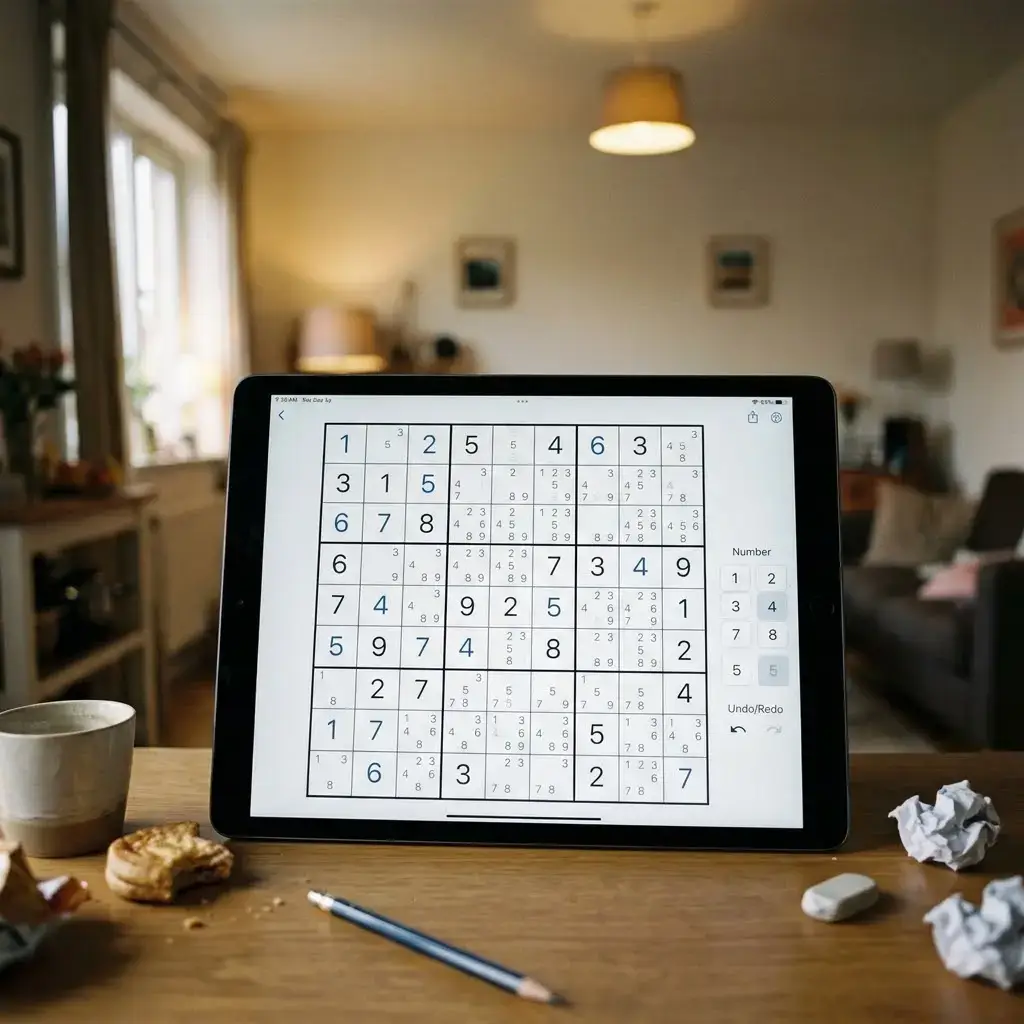
If you have searched for “hard Sudoku, difficult Sudoku,” recently, you may be looking for a bigger challenge — or simply wondering why Sudoku feels so difficult. The good news is that Sudoku is not math, and you do not need special logic skills to enjoy it.
Hard Sudoku and Difficult Sudoku Can Wait
A hard puzzle can be satisfying when you already have a comfortable routine. But starting with one can turn a peaceful brain exercise into an exhausting guessing game. Small print, crowded pencil notes, lack of knowledge, and long pauses can make anyone feel they are doing it wrong. You are not doing it wrong. You may simply be starting at the wrong level and without enough knowledge.
An easy standard 9×9 puzzle gives your eyes and brain room to learn the basic pattern: each row, column, and box needs the numbers 1 through 9, with no repeats. That is the whole puzzle rule. There are no calculations to perform.
Build a Calm Sudoku Routine First
At Sudoku123, the 1-2-3 method begins with a fresh approach. Rather than checking every number in order, you use random scanning and three simple, repeatable routines. Pencil notes are kept limited to two-cell and three-cell placements, so the page stays clear rather than cluttered.
You may not be familiar with this new solving technique, which is designed to take all the stress out of solving and to provide a comprehensive workout for your brain.
This matters because a daily puzzle should feel achievable. A few quiet minutes of looking, noticing, and placing a number can support focus and give your mind a pleasant task to return to. Like practicing a short piece of music, progress comes from familiar repetition, not from forcing yourself through the hardest piece first. In both cases, accuracy is of supreme importance.
A difficult puzzle invites mistakes. Finding and correcting them is a skill all of its own. See our blog
When Are Hard Puzzles a Good Choice?
Hard Sudoku may suit you later, once the easy Sudoku123 routine feels natural and you want a new kind of challenge. That path can require extra techniques and more patience and at least 30 easy puzzles. It is not a test of increased intelligence, but it will provide you with a sense of achievement and can significantly increase your enjoyment of Sudoku.
Brain exercise is not the same as muscle improvement. Over time, and with professional help, you can increase the weights on the bench press or extend a run with extra kilometres. Not so with a difficult Sudoku.
To prove the point in a musical sense
Imagine taking up piano lessons and attempting to play Rachmaninoff’s Piano Concerto No. 3 in D minor, Op. 30, within your first month. Without mastering basic scales and fingerwork first, it leads only to frustration.
Aspiring to tackle complex pieces is commendable, and creating a structured pathway to that goal is the best way forward.
In Sudoku, attempting high-level puzzles without a grounded routine often produces the same outcome. Errors, frustration and a brick wall.
In order to solve a truly difficult Sudoku puzzle, you eventually need to acquire a specialised vocabulary and skillset — understanding terms such as naked single, hidden single, hidden pair, triple, and a quad.
Recently, I joined a popular social media page designed to assist with hard-to-solve Sudoku puzzles. Katrina (not her real name) uploaded a photo of a puzzle she had almost completed. It was rated “Moderate”.
It was impressive, with very few pencil notes and a pair underlined.
Row two was clearly where she was stuck, as it contained a quad. Several other rows and columns had triples, all neatly set out and correct. Several well-meaning puzzlers had offered suggestions, but all were incorrect.
To solve the puzzle, Katrina needed to solve the quad. One correct 8 in the right cell, and the puzzle was finished. In addition, two sets of hidden pairs had been missed, as had a hidden single. All were picked up immediately as I subjected the puzzle to the ‘Sudoku123 treatment’.
Full marks to Katrina. Undoubtedly self-taught, she did a magnificent job, but as a quality brain exercise, struggling through that wall was not ideal, possibly leading to abandonment.
Puzzlers often give up entirely if they experience too many setbacks like this.
Looking Ahead: The Sudoku123 Members Area
Building that foundational confidence requires proper guidance. Brain training with our method typically involves completing at least 30 easy puzzles using the Sudoku123 method correctly.
To support you on this journey, we are currently planning to extend sudoku123.net to include a dedicated Members Area. As a member, you will gain exclusive access to our expanding knowledge base, step-by-step tips & tricks, and interactive tools designed to help you identify and apply advanced techniques smoothly when you feel ready to step up to higher-level puzzles.
For now, give yourself permission to start easy, follow one simple routine, and finish a puzzle at your own pace. Your brain needs exercise too, and a calm, enjoyable habit is the best place to begin.
Check out our Free Web-Site or our BLOG PAGES for further information and help.
Sudoku123 – encouraging mental health and brain exercise.
Disclaimer: Sudoku is a recreational activity for general well-being, not medical advice or a treatment for cognitive conditions.