
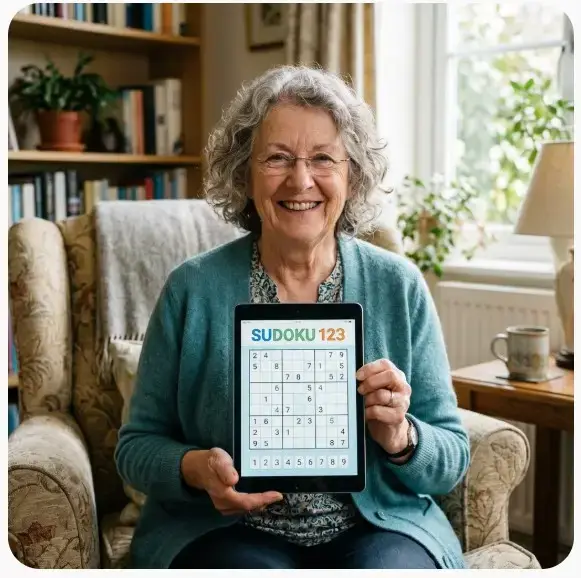
A returning player’s sudoku case study often begins with a familiar moment: someone opens a puzzle they once enjoyed, looks at the grid, and immediately feels stuck. They remember crossing out numbers in order, filling pages with notes, and spending far too long trying to find the next move. What was meant to be a pleasant mental exercise starts to feel like a test.
For many adults returning to Sudoku after a break, the obstacle is not ability. It is the pressure created by an old routine. They may believe Sudoku demands math skills, quick logic, or complicated strategies. It does not. A classic easy Sudoku is a pattern puzzle, and this calmer approach can make the difference between walking away frustrated and settling into a satisfying daily habit.
This composite case study reflects a common experience among returning players. It is not medical advice, and Sudoku is not a treatment for memory loss or any health condition. It is simply an accessible way to give the mind a gentle, focused activity.
The returning player who had lost confidence
Meet Linda, a 68-year-old retired office manager. She used to complete Sudoku puzzles in the newspaper during her lunch break. Years later, she tried again because she wanted a quiet activity for the morning with her coffee. Her first attempts did not feel relaxing.
Linda began the way she had been taught years ago. She chose the number 1 and searched every row, column, and box for every possible place it could go. Then she did the same for 2, 3, and onward. She found herself repeatedly checking the same squares. When she made pencil notes, they spread across the grid and made it harder to see what she was doing.
After several unfinished puzzles, Linda decided she was “not a Sudoku person anymore.” That conclusion is understandable, but it is rarely the whole story. Her difficulty came from a method that asked her to hold too much in mind at once.
The goal was not to make Linda work harder. It was to give her a smaller, repeatable routine that felt manageable from the first few minutes.
Why old Sudoku habits can get in the way
Returning players often bring a strong expectation that they should scan sequentially: Many “help” videos advocate this as a starting point. It is actually incorrect and hands the puzzler the justification of the earlier belief that “Sudoku is not for me”.
The problem is not that sequential scanning is wrong. The trade-off is that it can turn one simple grid into nine separate searches. A player may forget where they have looked, lose confidence in their notes, or feel discouraged when a number does not appear quickly.
For Linda, the first helpful step was permission to set the old method aside. A review of the Suddoku123 web-site confirmed that her earlier conclusions were wrong. In fact, trying to combine an old process with a new one would only create more confusion.
A fresh start matters. Sudoku123 teaches a 1-2-3 routine built around random scanning rather than checking numbers in strict order. Instead of asking, “Where can I put every 4?” the player calmly looks for an open square or an area that catches their eye, then checks its row, column, and box. This creates one clear task at a time. The puzzle can wait.
There is no mathematics involved. The numbers are simply symbols that must not repeat within a row, column, or 3-by-3 box.
What changed with the 1-2-3 routine
Linda began again with an easy standard puzzle. She watched the introductory guidance, Youtube Intro then followed a short demonstration before attempting the grid herself. Youtube Demo. This was important.
Reading about Sudoku can make it sound more complicated than it is, while seeing the steps carried out slowly helps the routine feel familiar.
Her new approach centered on three simple techniques. First, she scanned the grid at random rather than following the numbers in order. She looked for a sole candidate: a square where only one number could fit after checking the row, column, and box. (METHOD ONE). Next, when a square had two or three possible numbers, she used limited pencil notes only for those two-cell and three-cell placements. (Methods two and three).
Linda relaxed, gave herself permission to randomly scan the whole puzzle, and the puzzle waited until she was ready to place her next candidate.
The limit on notes made a real difference. Linda was no longer writing every possible number in every blank square. Her grid stayed readable. More importantly, she had a clear rule for when to pause and make a note, rather than guessing or filling the page with possibilities.
At first, she wanted to hurry. That is common for returning players who remember finishing puzzles more quickly in the past. But speed was not the purpose. She was encouraged to treat the puzzle as a small routine, much like practicing a few measures of music on the piano. Mary had a little lamb, not Chopin! Each correct placement gave her useful feedback: look carefully, apply the same three checks, and continue.
By the end of her first complete easy puzzle, Linda had not learned dozens of advanced strategies. She did not need to. She had learned a dependable process for finding the next sensible move.
Results that matter in an everyday routine
Over the next few weeks, Linda made room for an easy Sudoku several mornings each week. Some puzzles were completed in one sitting. Others were left on the table and finished later. Both approaches were useful because the routine fit around her day rather than becoming another obligation.
The most noticeable change was her attitude. She stopped describing Sudoku as something she “should be able to do” and began seeing it as a quiet period of concentration and brain exercise. She enjoyed noticing a number she had missed before, making a careful placement, and watching the grid gradually become more complete. That is cognitive exercise at work!
This kind of result is personal. One person may enjoy a 15-minute puzzle before breakfast; another may prefer five calm minutes in the afternoon. Some returning players want printed puzzles, while others prefer a screen. The best choice is the one that feels comfortable enough to repeat.
What should not be expected is a medical outcome. A daily puzzle can support a sense of focus, structure, and personal satisfaction, but it does not replace professional care or diagnose, prevent, or treat cognitive concerns. Anyone worried about changes in memory, mood, or daily functioning should speak with a qualified health professional.
Lessons from this returning players’ Sudoku case study
Linda’s experience points to a practical truth: returning players do not always need harder puzzles or more complicated teaching. Often, they need less pressure and a method that reduces the number of decisions required at any one moment.
Starting with an easy puzzle is not “starting small” in a negative sense. It is where the routine becomes clear. A player can practice scanning, checking a row, checking a column, checking a box, and making only the notes that genuinely help. Repetition builds familiarity without turning the activity into a competition.
It also helps to avoid comparing today’s puzzle time with the past. Perhaps you used to finish a grid quickly. Perhaps you never finished one at all. Neither fact decides what you can enjoy now. The useful question is simpler: did this puzzle give you a few minutes of calm attention and a feeling of progress? Does your mind feel sharper and more alert?
For people who have been put off by traditional Sudoku teaching, free access to a guided easy puzzle can be a gentle place to begin. Watch the short introduction, (see above) follow the demonstration, and allow yourself to use one routine consistently before judging the result.
Your brain deserves exercise, but exercise does not have to feel punishing. Choose an easy grid, keep your pencil notes light, and let one correctly placed number be enough reason to continue.
Check out our Free Web-Site or our BLOG PAGES for further information.