
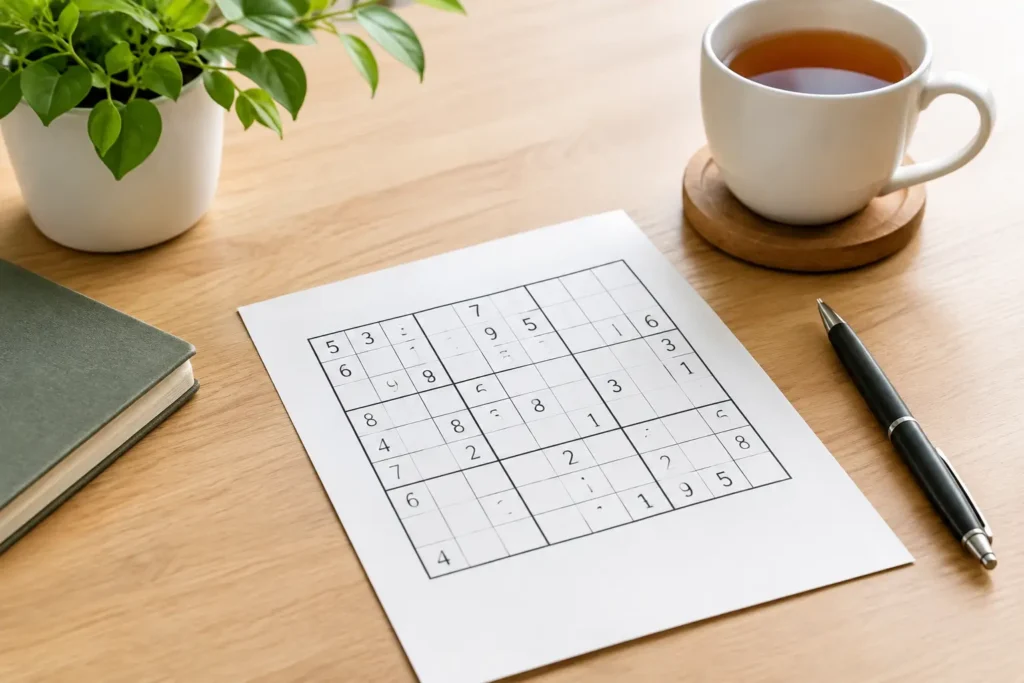
Easy 9×9 sudoku puzzles can be a welcome pause in a busy day: one page, a pencil, and a small task that asks for your attention without asking you to rush. You do not need to be good at math. You do not need to remember complicated strategies. You only need to notice what is already on the grid and take one calm step at a time.
For many people, Sudoku has a reputation for being difficult before they have even started. Rows of numbers can look like a test. They are not. A classic 9×9 Sudoku is a pattern puzzle. The numbers 1 through 9 are simply labels that help you see which spaces are available.
What Makes a 9×9 Sudoku Easy?
A 9×9 Sudoku grid contains 81 squares. It is divided into nine horizontal rows, nine vertical columns, and nine smaller 3×3 boxes. Your job is to place the numbers 1 through 9 so that each number appears once in every row, column, and box.
That is the whole rule set. There is no addition, subtraction, multiplication, or mental arithmetic involved. A 7 has no greater value than a 2. Each number is just a marker that cannot be repeated in the same row, column, or box.
Easy puzzles usually begin with more numbers already filled in. Those starting clues create obvious openings, so you can make progress by looking carefully rather than trying to predict several moves ahead. A well-chosen easy puzzle gives you frequent small wins. That matters when you are building a new habit or returning to Sudoku after a long break.
Difficulty can vary a little from one publisher to another. One site’s easy puzzle may feel more straightforward than another’s. The best starting point is not the puzzle with the fewest blank spaces. It is the puzzle that lets you understand why a number belongs in a square.
Start With the Three Places That Matter
Before writing a number, look at the square you want to fill. Then check its row, its column, and its 3×3 box. These are the only three places that can prevent a number from being used.
Imagine an empty square in a row that already contains 1, 2, 4, 6, and 8. The missing numbers are 3, 5, 7, and 9. Next, look down that square’s column. If the column already has 3 and 7, only 5 or 9 can remain. Finally, check the 3×3 box. If it contains 9, the answer is 5.
You do not have to perform this process quickly. In fact, slowing down is often the better choice. Give your eyes time to scan. Let the grid tell you what it needs. When the answer is not clear, move on to a different row, column, or box and return later.
Look for a Missing Number
The simplest way to begin is to find a row, column, or box that has only one blank square. If it contains eight of the nine numbers, the missing number is clear. Fill it in, then check again. One completed square often makes another answer easier to see.
This is a gentle way to build confidence because every move has a visible reason. You are not guessing. You are noticing what is absent.
Notice When Only One Square Will Work
Sometimes a row is missing several numbers, but one particular number has only one possible home. For example, a row may need 2, 5, and 8. After checking the columns and boxes for each empty square, you may find that 8 is blocked everywhere except one place. Put the 8 there.
This is still pattern recognition, not advanced logic. With practice, your eyes become more comfortable spotting these restrictions.
A Gentle Routine for Easy 9×9 Sudoku Puzzles
A calming Sudoku routine does not need to take an hour. Set aside a few quiet minutes with an easy puzzle, ideally at a time when you can focus without pressure. Some people enjoy a puzzle with morning coffee. Others prefer one after lunch or in the evening instead of more screen time.
Begin by scanning the grid for the most complete rows, columns, and boxes. Work through the obvious answers first. Then repeat the scan. This repeated routine is helpful because it removes the feeling that you must invent a clever new approach every time.
At Sudoku123,the guided 123 approach keeps the process simple by focusing on a small number of repeatable techniques. The aim is not to race or prove how much you know. It is to develop a familiar routine that helps you look, notice, and place numbers with growing ease.
If you reach a point where nothing stands out, resist the urge to force an answer. Put the puzzle down for a minute, take a breath, or scan a different box. Returning with fresh eyes can reveal a number that was there all along.
Why Guessing Can Make an Easy Puzzle Feel Hard
When a puzzle feels stalled, guessing may seem tempting. Yet one incorrect number can create confusion several steps later. Suddenly, a row appears to have no possible answer, and the relaxed activity starts to feel frustrating.
A better habit is to leave a square blank until you can explain its answer. You might quietly say, “This number is missing from the row, and it cannot go in the other open squares.” That simple explanation is enough.
If you make a mistake, it is not a failure. Check the row, column, and box around the problem area. Remove the number that does not fit and continue. Pencil marks are useful if you like to note possible numbers, but they are optional. Beginners often do well by keeping the page uncluttered and focusing on one confirmed placement at a time.
Choose Progress Over Speed
Easy Sudoku is most rewarding when it is treated as a personal activity, not a competition. Completing a puzzle in 15 minutes can feel satisfying. Completing it over several short sessions can feel equally satisfying. The useful pace is the one that leaves you feeling settled and pleased to return tomorrow.
A regular puzzle habit may support concentration, observation, and a sense of structure in the day. It is a recreational brain exercise, not a medical treatment or a substitute for professional health advice. Still, the act of giving your attention to a clear, manageable task can be a meaningful part of general wellbeing.
There is also value in stopping before you are tired. You do not need to finish every puzzle in one sitting to get something from it. A few thoughtful moves can be enough to create a moment of focus.
When You Are Ready to Move Forward
Stay with easy 9×9 Sudoku puzzles for as long as they feel enjoyable. There is no prize for moving to a harder level before you want to. A puzzle that offers steady progress is often better for building confidence than one that leaves you stuck.
When easy grids begin to feel familiar, you may notice that you scan more naturally. Missing numbers stand out. You recognize which box to check next. That change comes from repetition, not from special powers or a talent for math.
Keep one easy puzzle nearby for a quiet break. Each square you solve is a small reminder that calm attention grows through practice, one clear number at a time.