
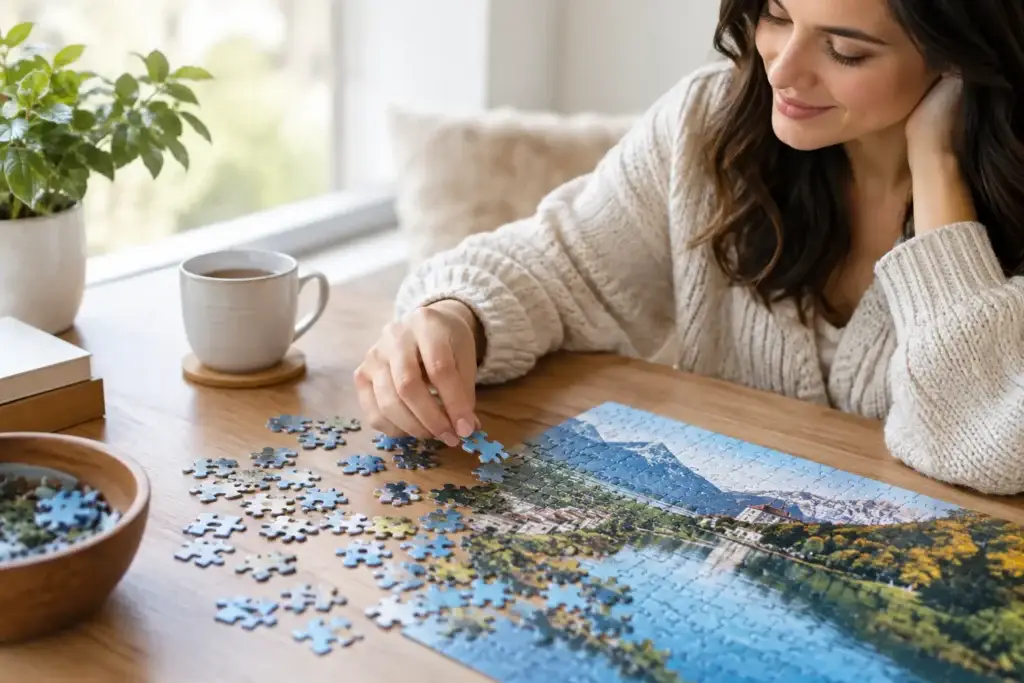
A quiet puzzle can change the shape of an afternoon. Instead of filling every spare moment with noise, news, or another task, you can sit down with a clear little challenge and give your attention somewhere gentle to go. The best relaxing puzzle games are not necessarily the hardest ones. They are the games that feel welcoming, give you a manageable next step, and leave you with the satisfying sense that you have spent a few minutes well.
For many adults, especially those returning to puzzles after years away, relaxation comes from knowing there is no race to win. There is no need to prove anything. A good puzzle simply asks you to notice, consider, and continue at your own pace.
What Makes a Puzzle Relaxing?
A relaxing game has enough structure to hold your focus, but not so much pressure that it becomes frustrating. It should be easy to pause, easy to return to, and possible to enjoy without a screen full of flashing prompts or a countdown clock.
The right choice also depends on the kind of calm you need. Some people relax by looking for visual patterns. Others prefer letters, familiar words, colors, or simple number placement. There is no single best puzzle for everyone. The most useful one is the one you will happily come back to tomorrow.
10 Best Relaxing Puzzle Games to Try
1. Easy Sudoku
Sudoku is one of the best choices for a calm daily brain exercise because each puzzle has a clear purpose. You place the numbers 1 through 9 so they appear once in each row, column, and 3-by-3 box. It is not mathematics, and you do not need to add, subtract, or calculate anything.
The key is to start easy. An easy Sudoku lets you practice observation without getting tangled in difficult strategies. If traditional Sudoku lessons have made you feel that you must check numbers in a strict sequence, set that idea aside. A simpler random-scanning routine can make the process feel more natural and far less intimidating.
2. Jigsaw Puzzles
Jigsaw puzzles offer a slower, visual kind of focus. You can sort pieces by color, find an edge, or simply work on one small area of the picture. There is no requirement to see the whole answer at once.
A physical puzzle can be particularly comforting because it gets you away from notifications. Digital jigsaws are useful, too, especially when table space is limited. Choose images that feel pleasant to look at, such as gardens, animals, landscapes, or familiar places.
3. Word Searches
A word search is simple to begin and easy to put down. You scan for a word, spot a few letters, and follow the line. That steady visual search can settle a restless mind without demanding too much energy.
Theme-based word searches can add a personal touch. Try travel, music, nature, sports, or seasonal words. Larger print versions are often a better choice than small, crowded grids, since comfort matters as much as challenge.
4. Crosswords With Gentle Clues
Crosswords can be wonderfully satisfying when the clues are matched to your experience. An easy or medium puzzle with familiar vocabulary encourages recall and keeps you engaged. A puzzle filled with obscure trivia, however, can turn a peaceful break into a test.
If you enjoy crosswords but get stuck, give yourself permission to skip a clue and return later. The goal is not to finish every square perfectly. The value is in the attention you give the puzzle and the small moments when an answer comes to you.
5. Nonograms
Nonograms, sometimes called picture logic puzzles, use numbered clues to reveal a hidden image. You mark squares on a grid until a pattern becomes clear. They suit people who enjoy order and visual progress.
These puzzles can become complex, so choose beginner grids with small pictures. The pleasure comes from watching a simple image appear one section at a time, not from tackling the largest grid available.
6. Match-Three Games Without Timers
Color-matching games can be relaxing when they allow you to play without a countdown. Looking for three matching pieces gives the mind a straightforward job, and the repeated movement can feel pleasantly absorbing.
Be selective here. Some games are designed to hurry you, interrupt you, or push you toward purchases. A calmer version lets you make one move, think briefly, and continue without pressure. If the sounds or animations feel busy, turn them down or choose a quieter game.
7. Mahjong Solitaire
Mahjong solitaire is a tile-matching game that rewards patient observation. You look for matching open tiles and gradually clear the board. The pace is yours, and the visual layout gives your eyes a restful task.
A beginner layout is best at first. It helps to choose tile sets with clear symbols and good contrast. When you can see the tiles comfortably, the game feels like a peaceful sorting activity rather than a strain.
8. Spot-the-Difference Puzzles
Two nearly identical pictures with a handful of changes can provide a lovely short break. These puzzles invite careful looking without requiring you to remember rules or learn new techniques.
They work well when you only have five or ten minutes. A cup of tea, a comfortable chair, and one picture can be enough to reset your attention before you move on with the day.
9. Tangrams and Shape Puzzles
Tangrams use a small set of geometric pieces to make animals, objects, and patterns. They are hands-on, visual, and often surprisingly calming. You can rotate a piece, try a new arrangement, and learn through gentle trial and error.
These puzzles are especially enjoyable if word games do not appeal to you. The shapes give you something concrete to move and consider, with no need for vocabulary or numerical skill.
10. Coloring Puzzles and Color-by-Number
Color-by-number games sit somewhere between a puzzle and a creative activity. The next step is always clear, yet the finished page gradually becomes your own piece of color and pattern. That predictability can be very reassuring on a busy day.
Choose designs with larger sections if you want a more comfortable experience. Fine, detailed pages can be enjoyable, but they may not feel restful when your eyes are tired.
How to Choose the Best Relaxing Puzzle Games for You
Start with the puzzle type that feels least demanding. If you enjoy familiar words, try a word search. If you prefer a clear set of rules, choose easy Sudoku. If you want something visual and hands-on, a jigsaw or tangram may be a better fit.
Keep the difficulty low enough that you can experience progress. Harder is not automatically better. A puzzle that leaves you feeling capable is more likely to become a regular habit than one that leaves you stuck. Completing an easy puzzle can be as rewarding as learning a new piece of music on the piano – one small section at a time, then the pleasure of hearing it come together.
At Sudoku123, the focus is on making easy 9-by-9 Sudoku feel approachable through three repeatable routines, including limited pencil notes and a relaxed scanning method. You do not need previous Sudoku experience, advanced logic, or any special talent with numbers. A calm routine is the point.
Make Your Puzzle Time a Daily Pause
A puzzle does not need to take an hour to be worthwhile. Ten or fifteen minutes after breakfast, during an afternoon break, or before bed can create a dependable moment of focus. Keep a favorite puzzle book near your usual chair, or choose one easy digital game that you can open without searching through options.
Try to protect the peaceful part of the activity. Turn off unnecessary alerts. Use good lighting. Wear reading glasses if they help. Stop before you become overtired or frustrated. The best routine is one that leaves you feeling steadier than when you began.
Puzzles can support concentration, observation, and a sense of everyday accomplishment, but they are recreational activities, not medical treatment or a way to diagnose, prevent, or treat cognitive conditions. If you have concerns about memory or changes in thinking, speak with a qualified health professional.
Choose one easy puzzle today and let yourself enjoy just the next move. A calm mind does not need a perfect performance – it simply needs a quiet place to practice paying attention.