
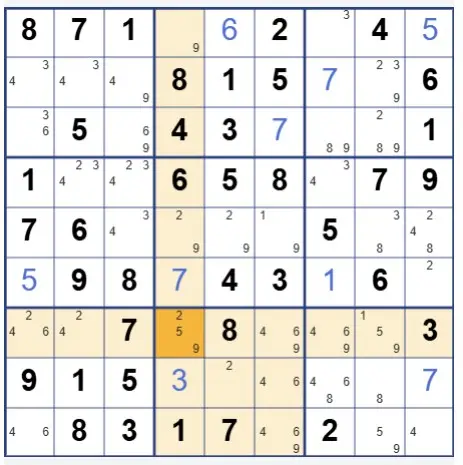
A nearly completed Sudoku can feel frustrating when one empty square refuses to reveal itself. This is where learning to use pencil marks in Sudoku can bring a welcome sense of order. They are not a sign that you are stuck or doing the puzzle incorrectly. Used simply, pencil marks help you see what is possible without trying to hold every option in your head.
At Sudoku123, pencil marks are part of a calm routine for an easy standard puzzle. There is no math involved, no need to race, and no need to memorize a long list of complicated strategies. You are simply looking, noticing, and making a small note when it helps. Study the picture above to see how a minimum of pencil notes makes a huge difference.
What Pencil Marks Mean in Sudoku
A pencil mark is a small number written in an empty square to show that the number may belong there. It is not a final answer. Think of it as a gentle reminder: “This square is worth watching.”
Every Sudoku follows three straightforward rules. Each row must contain the numbers 1 through 9 once. Each column must contain the numbers 1 through 9 once. Each 3-by-3 box must also contain the numbers 1 through 9 once. Pencil marks give you a way to record the numbers that are still allowed in a particular square under those rules.
Traditional Sudoku instruction often encourages players to fill every blank square with a long collection of tiny possible numbers. For many people, especially beginners or returning players, that can make the page look crowded and tiring. Instead of making the puzzle clearer, it can make it harder to know where to look next.
The Sudoku123 approach keeps things lighter. Pencil notes are used only when two empty squares or three empty squares are the possible places for a number within a row, column, or box. That limit matters. It keeps your attention on useful information rather than covering the puzzle in tiny writing. The picture above shows several cells with a sole candidate. This approach can assist in finding both sole candidates and hidden singles.
Why Simple Pencil Marks Feel Easier
A Sudoku puzzle asks you to observe patterns. If you try to remember every possibility at once, the task can feel larger than it really is. A small pencil note takes that one detail out of your memory and places it where you can see it.
This can make the next step feel less pressured. You do not have to solve the whole grid in one sitting of thought. You only need to notice one number that has two or three possible positions, mark those positions, and continue your scan.
For a daily mental exercise, this slower and clearer approach has another benefit: it encourages focus without turning a quiet puzzle into a test. You may find that a few minutes of careful observation helps settle your attention after breakfast, during an afternoon break, or before bed. Sudoku is a recreational activity, not medical treatment, but many people enjoy it as a regular way to keep their minds actively engaged.
How to Use Pencil Marks in Sudoku (THE 123 METHOD)
Before making any notes, look for numbers that can be placed immediately. (This is method one) Scan the puzzle in a relaxed, random order rather than checking number 1, then number 2, then number 3 all the way through. You might notice a helpful row first, then move to a box, then return to a column. There is no prize for following a strict sequence.
When you focus on one number, ask a simple question: where can this number go in this row, column, or box? Mentally cross out places that already contain that number. Then notice how many blank squares remain possible.
If there are only two possible squares, write a small pencil mark for that number in both squares. (This is method two) If there are three possible squares, write the same small mark in all three. (This is method three) If there are four or more possibilities, do not mark them. Leave the area alone and continue scanning elsewhere.
This is the heart of the routine. You are not trying to create a complete catalog of candidates. You are only recording the situations that are limited enough to become useful later.
A simple example
Imagine you are scanning for the number 6 in one 3-by-3 box. The box already has several numbers filled in. After checking the matching rows and columns, you find that 6 can only go in two empty squares.
Write a small 6 in each of those two squares. Neither square is solved yet, but you have captured something valuable. If a 6 is later placed elsewhere in one of the connected rows or columns, one of your pencil marks will no longer be possible. The remaining marked square becomes the answer.
The same idea works when a number has three possible squares. Make the three small notes, then let the rest of the puzzle provide more information. As new answers appear, revisit the marks naturally during your next scan.
Keep Your Notes Useful, Not Busy
Pencil marks work best when they are easy to read. If you are solving on paper, make them small and place them consistently in the same part of each square. If you are using a digital puzzle, use the notes feature only for these two-position and three-position possibilities.
Remove a note as soon as the number is no longer possible in that square. This small act of clearing your work helps the grid stay calm and readable. It also gives you a satisfying visual sign that the puzzle is moving forward.
There is a trade-off here. Full candidate marking may be useful for very difficult Sudoku puzzles (currently not advised) and advanced solving methods. But for an easy standard puzzle, more information is not always better information. A page full of notes can pull your attention away from the basic observations that make Sudoku approachable.
If you have learned Sudoku another way before, it may help to set those habits aside while practicing this routine. You do not need to check every number in numerical order. You do not need to fill every empty square with possibilities. Give the simpler method a fair try on an easy puzzle, where you can see how scanning and limited notes work together.
Pair Pencil Marks With the 1-2-3 Routine
Pencil marks are one part of a repeatable Sudoku habit, not the entire puzzle. Start by scanning for an obvious placement. Next, look for a number that has only one available place in a row, column, or box. Then use pencil marks when a number has exactly two or three possible places.
After that, move on. Look somewhere else in the grid. A new answer in another area may be the detail that turns one of your notes into a clear solution. This is why random scanning can feel so freeing. You are allowed to leave a section and return later. The puzzle does not require you to force an answer. Changes to the puzzle structure will continue in other areas while you aren’t watching. The random method works in the background!
Try not to stare at one stubborn square for too long. When your eyes become fixed on a single area, take a fresh look at another row, column, or box. Often, the information you need is waiting somewhere nearby but outside your current focus.
Build Confidence One Easy Puzzle at a Time
The purpose of pencil marks is not to make Sudoku look more technical. Their purpose is to reduce guesswork and support your observation. Each small note says that you have noticed a real pattern and given yourself a clear path to revisit it.
Begin with an easy puzzle and give yourself permission to go slowly. A completed grid is rewarding, but so is recognizing that you understand one more part of the process than you did yesterday. Like practicing a short piece of music, repetition makes the movements feel more familiar.
If you would like guided practice, Sudoku123 offers FREEE access to an introductory routine, a short demonstration, and an easy puzzle example on our YOUTUBE CHANNEL. Start where you are, use only the notes that genuinely help, and let each quiet solve become a few minutes reserved for your own focused attention.