
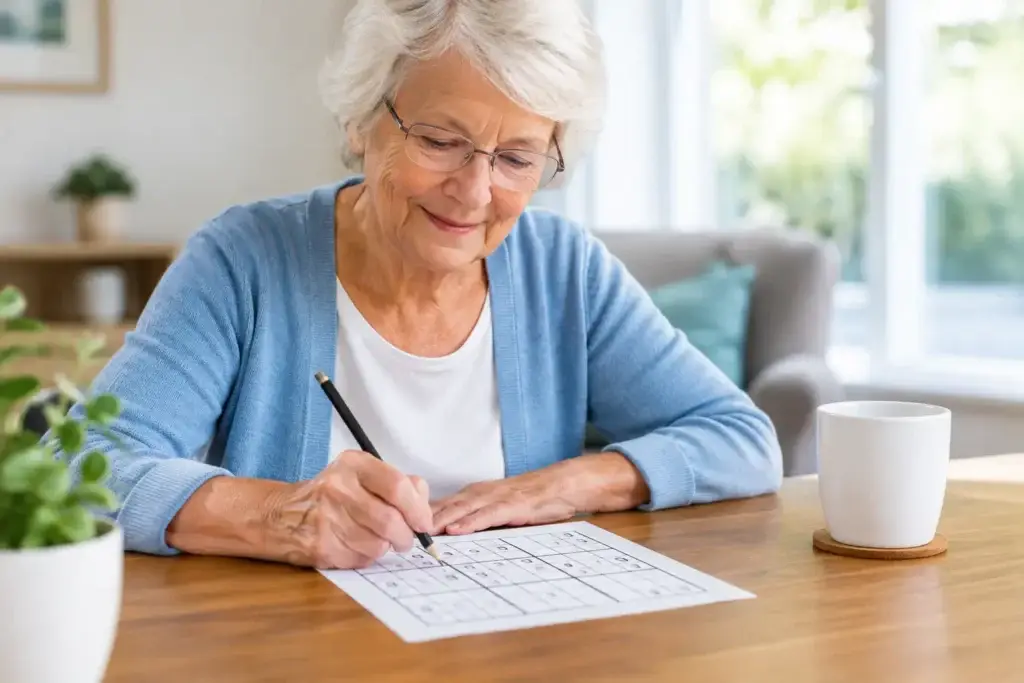
A good care home sudoku example should never make a resident feel tested. It should create a quiet, satisfying moment: a large-print puzzle, a pencil, a cup of tea nearby, and one small square that suddenly makes sense. Sudoku is not math, and it does not require special logic skills. It is simply a gentle way to look, notice, and place one number at a time.
For many older adults, traditional Sudoku can look intimidating before they even begin. A page full of tiny numbers may suggest complicated rules or a fear of getting it wrong. The answer is not to push harder. It is to make the first experience easier, slower, and more welcoming.
What Makes Sudoku Suitable for a Care Home?
The best Sudoku activity is an easy standard 9 by 9 puzzle, presented clearly and without a race to finish. Residents should be free to work alone, alongside a friend, or with a staff member offering calm encouragement. The purpose is not competition. It is a pleasant daily brain exercise that supports attention, observation, and the rewarding feeling of completing a structured task.
There are only three things to remember. Every row needs the numbers 1 through 9 once. Every column needs the numbers 1 through 9 once. Every 3 by 3 box needs the numbers 1 through 9 once. No adding, subtracting, or calculating is involved.
That is enough to begin. A resident does not need to remember long chains of logic or check every number in order. In fact, a gentler random scanning routine can feel far more natural. Look at any row, column, or box that catches the eye, notice what is missing, and see whether one space is the obvious home for a number.
A Care Home Sudoku Example to Use
Here is an easy puzzle suitable for a relaxed group or individual activity. A dot means the square is empty. If printing it, use a large, dark font and leave plenty of space around the grid for comfortable pencil marks.
“`text 5 3 . | . 7 . | . . . 6 . . | 1 9 5 | . . . . 9 8 | . . . | . 6 . ——+——-+—— 8 . . | . 6 . | . . 3 4 . . | 8 . 3 | . . 1 7 . . | . 2 . | . . 6 ——+——-+—— . 6 . | . . . | 2 8 . . . . | 4 1 9 | . . 5 . . . | . 8 . | . 7 9 “`
Before anyone writes a number, invite them to take a slow look. There is no need to understand the whole puzzle. Ask, “Which box looks like it already has quite a few numbers?” The top-left 3 by 3 box contains 5, 3, 6, 9, and 8. It is missing 1, 2, 4, and 7.
Now choose just one missing number to look for. For example, consider the number 1. In that top-left box, the second row cannot take a 1 because there is already a 1 in that row. The first row also cannot take a 1 because of the other numbers across the row. This leaves the empty square at the beginning of the third row. Write in 1.
That small success matters. It gives the player proof that the puzzle can be handled one clear observation at a time.
Use Random Scanning, Not a Rigid Search
Many people are taught to begin with the number 1 and work through every row, then repeat the process for 2, 3, and so on. That can feel tiring, especially for someone new to Sudoku or returning after a long break.
A more comfortable approach is to scan randomly. Look at a box with lots of numbers. Then look at a row that seems nearly complete. Then perhaps return to a column. There is no penalty for changing direction. The puzzle will wait.
This is the heart of the Sudoku123 approach: use a simple, repeatable routine rather than trying to force traditional solving habits. Previous Sudoku experience can sometimes make a beginner second-guess themselves, so it helps to let old routines go and work in this new, calmer way.
Keep Pencil Marks Small and Useful
Sometimes a square will have two possible numbers. Sometimes it will have three. Those are the only pencil notes needed for a gentle beginner routine. Write the possible numbers lightly in the empty square, then move on.
For example, if a space could be either 2 or 4, write a small “2,4” in that square. If it could be 2, 4, or 7, write “2,4,7.” Do not fill a square with many tiny guesses. Too much detail can turn a peaceful activity into a crowded page.
When a number is placed elsewhere, revisit the pencil-marked square. One possibility may disappear, leaving the answer clear. This is a quiet, repeatable process, and it can be especially reassuring for residents who worry about making mistakes.
How to Run the Activity Without Pressure
A care home Sudoku session can be as short as 10 or 15 minutes. One resident may complete only a few squares. Another may prefer to keep going after lunch. Both experiences are worthwhile.
Start by introducing the puzzle as a shared observation activity, not a lesson. Say something like, “Let’s see what numbers are already here and find one empty space that gives us a clue.” That wording is kinder than asking someone to solve a puzzle.
Staff can point to the relevant row, column, and box while letting the resident make the final choice. If the answer does not come quickly, move to a different area of the grid. A pause is not failure. It is part of the routine.
For a small group, give each person a copy rather than asking everyone to follow one board. Some residents will enjoy talking through a square together; others may concentrate better in silence. Offer both options. A calm room, good lighting, glasses within reach, and thick pencils can make a real difference.
Adapt the Puzzle to the Person
Not every resident will enjoy a full 9 by 9 grid at first. Someone with reduced vision may need extra-large print or a high-contrast page. A person with arthritis may find a pencil grip more comfortable. Someone who becomes overwhelmed by a whole grid may do better with a card covering all but one 3 by 3 box.
It also depends on the resident’s mood that day. On a lively day, Sudoku can be a friendly table activity. On a quieter day, it can be a peaceful individual task. There is no need to correct every wrong entry immediately. A gentle question such as, “Shall we check the column together?” protects confidence while guiding attention back to the three simple rules.
Avoid turning the activity into a measure of ability. A resident who cannot finish a puzzle has still spent time noticing patterns, making choices, and engaging with a familiar routine. The enjoyment and sense of participation are more valuable than a completed page.
Make It Part of a Gentle Daily Routine
Consistency can make Sudoku feel more familiar. Try offering an easy puzzle at the same time each day, perhaps after breakfast, during a quiet afternoon period, or before an activity group begins. Keep the same simple instruction: find one number that has only one possible place.
Sudoku123 offers free access to an easy standard puzzle and short guidance for people who want to learn this 1-2-3 routine at their own pace. The goal is not to move residents toward harder puzzles. It is to help them enjoy an achievable activity that feels clear, calm, and rewarding.
Sudoku is a recreational brain exercise, not medical treatment or a substitute for professional health advice. Still, a familiar pencil-and-paper moment can give someone a reason to sit comfortably, focus on one small task, and feel pleased with what they notice. Put the puzzle on the table, begin with one box, and let the next square come when it is ready.