
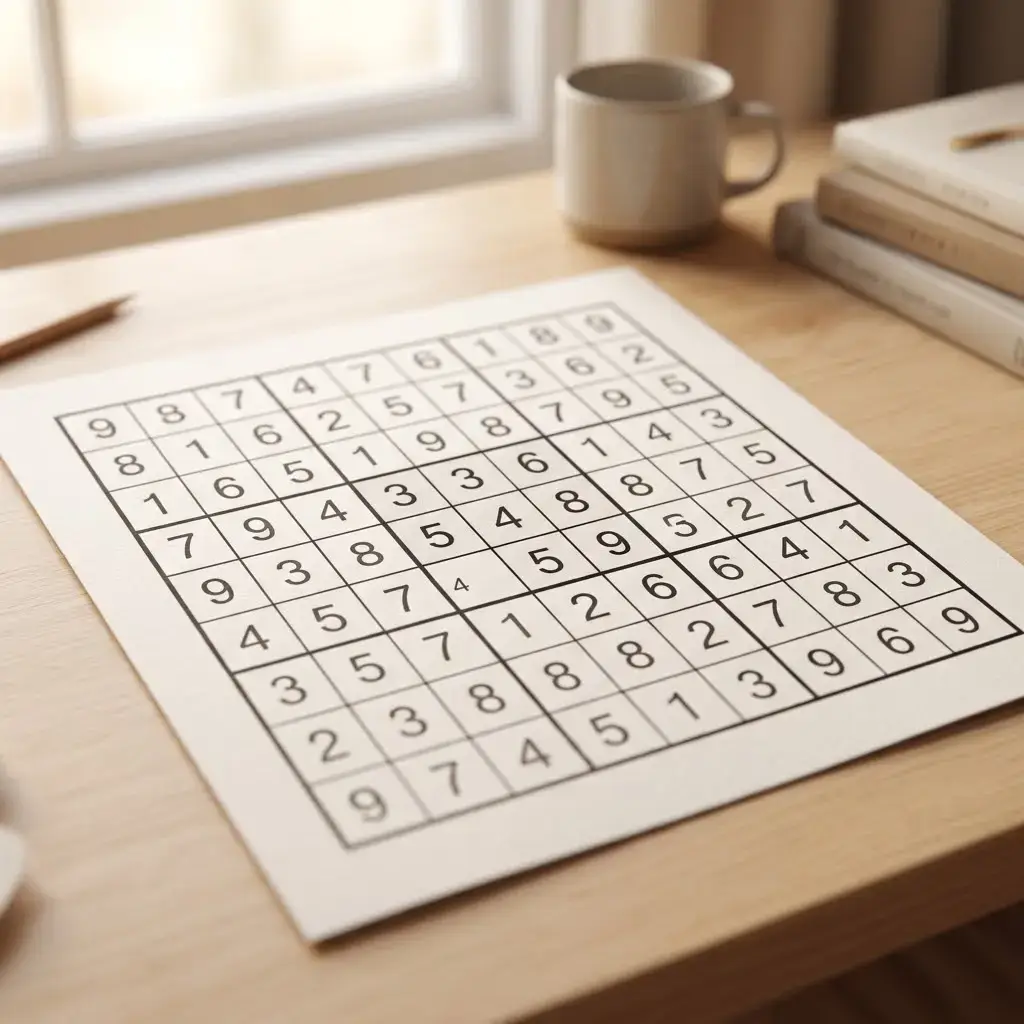
A blank Sudoku grid can feel louder than it looks. There are 81 little squares, nine boxes, and a row of numbers that may seem to be waiting for you to make a mistake. That is exactly why learning how to start Sudoku calmly matters. You do not need to race, calculate, or remember complicated rules. You only need a quiet routine and one easy puzzle.
Sudoku is not mathematics. The numbers are simply symbols used to organize the grid. You could replace them with letters or colors and the basic task would stay the same. Your job is not to be clever. It is to notice what is already there, make one small choice, and repeat.
For many people, especially those returning to puzzles after years away, the calmest beginning is also the most useful one: let go of the old ways you may have been taught. Sequentially checking number after number can become tiring and frustrating. A simpler 1-2-3 routine uses random scanning, giving your eyes permission to look wherever they naturally land.
Sudoku is not a puzzle in the true sense of the word. What you see in front of you is a completed Sudoku that has been “deconstructed”. Many numbers have been removed according to the difficulty level required.
Your task is to reinstate the puzzle back to its original state. If you are new to Sudoku, a YouTube video shows you how. You can also start at the web page Sudoku123 and view a short demo video.
Begin With an Easy Puzzle, Not a Challenge
Starting with a hard Sudoku is like choosing a difficult piano piece before learning where the keys are. It may be possible eventually, but it is not the kindest way to begin. An easy, standard 9×9 puzzle gives you room to learn the routine without feeling pressured.
Choose a time when you can sit comfortably for 10 to 15 minutes. A morning coffee, a quiet afternoon break, or the period after dinner can all work well. Keep a pencil nearby if you are using paper, or use a screen/tablet that is easy to see. The aim is not to finish quickly. The aim is to give your attention one pleasant, structured place to rest.
Before you begin, make one agreement with yourself: you are allowed to pause. If a square does not make sense, leave it alone and look elsewhere. There is no prize for staring at one box until it becomes irritating. A calm Sudoku routine moves on, then returns later with fresh eyes.
The Only Three Rules You Need
A classic Sudoku has nine rows, nine columns, and nine smaller 3×3 boxes. Each row must contain the numbers 1 through 9 once. Each column must contain the numbers 1 through 9 once. Each small box must also contain the numbers 1 through 9 once.
That is all.
You do not add the numbers. You do not subtract them. You do not need a head for math or special powers of logic. You are simply looking for a number that is missing and checking whether it can fit without repeating in its row, column, or box.
At first, it may help to say this quietly: “This number cannot go there because it is already in the row, column, or box.” That simple observation is the foundation of the whole puzzle. Over time, your eyes may begin to notice these patterns more naturally, but there is no need to force that process.
How to Start Sudoku Calmly With Random Scanning
Traditional Sudoku advice often tells people to begin with the number 1 and work through every row, then repeat with 2, 3, and so on. For some players, that feels orderly. For many beginners, it feels like another rule to remember and inevitably leads to frustration.
The Sudoku123 approach is different. Start by looking anywhere in the grid. Let your eye settle on a box, a row, or a number that catches your attention. Then ask one gentle question: “What number might fit in this empty square?”
Perhaps you notice a small box that already has seven numbers filled in. It has only two empty spaces, which makes it a friendly place to look. Check which numbers are missing. Then look along the rows and columns connected to those spaces. If only one of the missing numbers can fit in a square, write it in or pencil both numbers in and move on.
After that, scan somewhere else. You do not have to follow a neat path from left to right or top to bottom. Random scanning keeps the process lighter. It also helps you to avoid becoming stuck in one corner of the grid simply because you think you “should” finish it first.
This is not careless solving. It is a repeatable routine that places observation before pressure. Each correct number creates a little more information for the next random scan.
Use Pencil Notes Sparingly
Some Sudoku methods fill empty squares with long lists of possible numbers. That can make a page look crowded very quickly, especially if you are new to the puzzle. It may also pull attention away from the calm, simple task in front of you.
A gentler approach is to use pencil notes only when an empty square has two or three possible numbers. Write those possibilities lightly in the square. These notes are not a test and they are not permanent. They are simply a reminder for your future self.
For example, if a square can only be a 4 or a 7, note those two possibilities. Continue scanning the puzzle. Later, another number placed in the same row, column, or box may remove one option. The answer then becomes clear without guesswork.
Avoid filling every blank square with notes. If a space has many possible choices, leave it open for now. A less cluttered grid is easier to read, and it supports a steadier mind. Your pencil marks should help you see, not give you more to manage. Relax, the puzzle will wait for you!
Let One Good Move Be Enough
The most common beginner mistake is not choosing a wrong number. It is expecting every look at the puzzle to produce an answer. Sometimes you will scan a row, check a box, and find nothing certain. That is completely normal.
When that happens, move to another area. You might spot a sole candidate, meaning only one number can fit in a square. Or you may notice that, within a box, a certain number has only one possible location. These are small discoveries, but they are satisfying because they come from careful observation rather than a complicated trick.
Think of Sudoku as a series of single steps. You do not need to see the whole route before you begin. One correct placement can change a row. That row can change a box. That box can make another placement possible. Progress often arrives quietly. Important!
If you make an error, there is no need to be hard on yourself. Erase it, take a breath, and return to the rules. Check the row, column, and box. Mistakes are part of learning any new routine, whether you are practicing a tune, gardening, or trying a puzzle for the first time.
Make Sudoku a Gentle Daily Brain Exercise
A short Sudoku session can be a rewarding way to practice concentration and observation. Many people enjoy the feeling of settling their attention on one manageable task, particularly during retirement, a quiet break, or a period when the day feels scattered.
It is best to keep the benefit in perspective. Sudoku is recreational mental activity, not medical treatment, and it does not diagnose, prevent, or cure memory conditions. If you have concerns about memory or cognitive changes, speak with a qualified health professional. Still, a simple daily puzzle can be a pleasant part of a broader routine that includes movement, connection, rest, and activities you enjoy.
Consistency matters more than difficulty. One easy puzzle completed at your own pace can feel far more rewarding than struggling through a puzzle designed to frustrate you. There is no need to move on to harder levels simply because someone else does. The right puzzle is the one that leaves you feeling focused, capable, and ready to come back tomorrow.
Give Yourself Permission to Be a Beginner
If Sudoku has intimidated you before, begin again with a clean slate. Forget the idea that you must be naturally good at puzzles. Forget the pressure to use complicated strategies or finish in record time. The 1-2-3 routine is built around three simple, repeatable actions: scan freely, place what is certain, and use only light two- or three-number pencil notes when needed.
A short introductory video or a demonstration of an easy puzzle can make the first session feel even more comfortable. Watching someone work through the routine helps show that the process is calm, practical, and achievable. Sudoku123 offers free access to this kind of guided start, along with a community contact pathway for those who want more information.
Set out your puzzle, take the first number you can genuinely see, and let that be enough for today. A quiet square solved with confidence is a very good place to begin.
Check out our Free Website or our BLOG PAGES for further information and tips and tricks.