
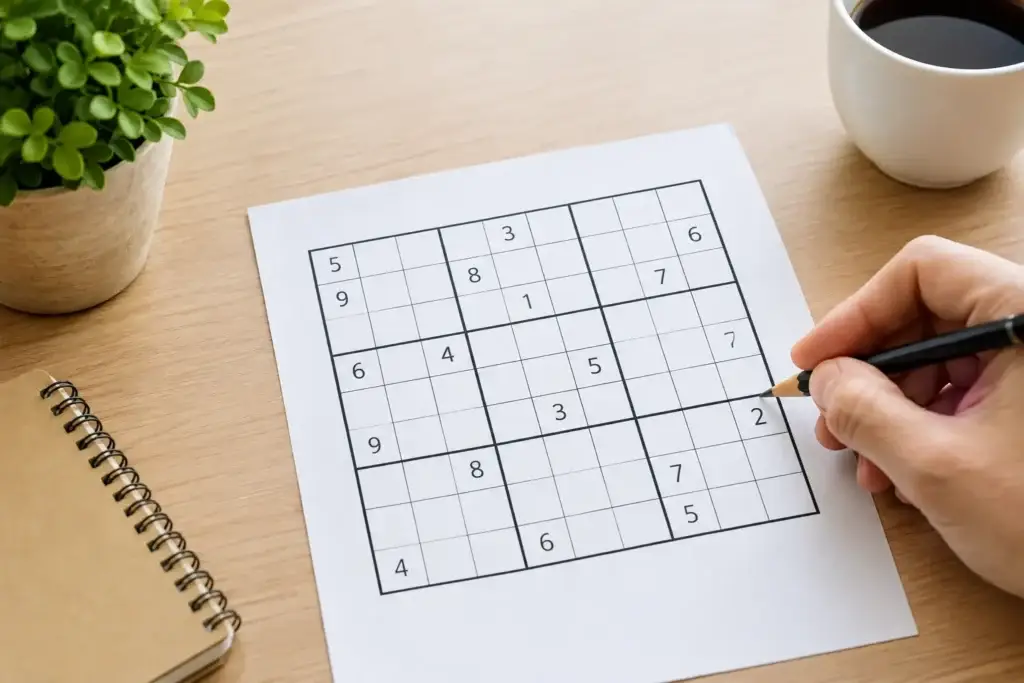
A nine-by-nine sudoku puzzle can look busy at first: 81 small squares, several numbers already in place, and plenty of blank spaces. Yet the task is much simpler than it appears. You are not doing math, racing a clock, or expected to use complicated logic. You are simply looking for where each number from 1 through 9 belongs.
For many adults, especially those returning to puzzles after years away, that distinction matters. Sudoku can be a peaceful pause in the day – a structured activity that gives your attention somewhere useful to rest. With a calm routine, an easy puzzle, and a little patience, the grid becomes familiar surprisingly quickly.
What Is Nine by Nine Sudoku?
Classic nine-by-nine sudoku is a square grid made of nine rows and nine columns. The grid is also divided into nine smaller boxes. Each small box contains three rows and three columns.
The goal is to place the numbers 1 through 9 so that every row, every column, and every three-by-three box contains each number once. A number cannot appear twice in the same row, column, or box.
That is the whole rule set. There is no adding, subtracting, multiplying, or remembering formulas. The numbers are labels, much like nine different colors or nine letters. A 7 has no greater value than a 2. It simply has to occupy the one square where it fits without repeating in its row, column, or box.
When beginning, it helps to look at one empty square rather than the whole puzzle. Ask three quiet questions:
- Which numbers are already used in this row?
- Which numbers are already used in this column?
- Which numbers are already used in this box?
The missing number may then be clear. If it is not clear yet, that is completely fine. Leave the square and look elsewhere. An easy Sudoku is not solved by forcing every space in order. It is solved by noticing the opportunities that are ready.
Why the three-by-three box matters
Many beginners remember to check rows and columns but forget the box/square. The square is often the piece that makes a placement obvious. For example, a square might be free in its row and column for a 4, but if its three-by-three square already contains a 4, that square cannot hold it.
Checking all three areas may sound like a lot. With repetition, though, the eye starts to recognise the pattern. You may begin to notice a missing number in a box before you consciously list every number. That is not a special talent. It is familiarity growing through a simple repeated routine.
A Calm Nine-by-Nine Sudoku Routine
Traditional Sudoku instruction often tells players to work through the numbers in sequence: find all the 1s, then all the 2s, then all the 3s. Some people enjoy that approach. Others find it tiring, slow, or overly technical because it asks them to hold one number in mind for a long time.
A gentler alternative is random scanning. Instead of starting with a particular number, let your eye move around the puzzle. Look at a row, then a square, then another area that catches your attention. When you see an easy placement, make it. Then scan again.
A random scanning technique gives you a huge advantage. Rather than maintaining a routine that requires you to keep track of which number sequence you are using, you can simply roam around the whole puzzle, assured that the puzzle will come out, as long as there are no mistakes.
Sudoku123 teaches this kind of beginner-friendly routine through three repeatable actions. Scan the grid freely for an obvious single placement. Next, use pencil notes only when a square has two possible numbers, and use pencil notes when a square has three possible numbers that the number you are considering could be placed in. Keeping notes limited in this way helps prevent the page from becoming crowded with tiny numbers.
The Sudoku123 website has a video demonstration of these three solving methods, all three of which should be considered when scanning randomly over the puzzle.
Still not sure where to start? Watch how an easy puzzle is solved from start to finish here on YouTube
Start with obvious placements
Forget what you have been told! The only place to start solving a puzzle is the place your eyes land on as you spot a cell that can have the correct number. Move from there, randomly, until you can see another placement, a single correct solve, or two pencil notes, or three pencil notes, never more than that.
Why scan the grid RANDOMLY?
For those of you who are curious, the random scan method is the only way to solve number puzzles. The “whirlpool” effect comes into play just as a rock makes ripples on the surface of a pond. Finding a correct placement on one part of the grid has a ripple effect across the whole puzzle. You can’t be expected to know where the change has taken place; however, there is a good chance that you will come upon one of the changes during your random scan. Following a rigid pattern of “do the ones, then the twos, and so on” misses this important statistical anomaly and negates most of the benefits of the brain exercise that flows from this calming method.
Keep pencil notes light
Sometimes a square could contain either of two numbers. Rather than trying to hold both possibilities in your memory, write those two small numbers in the square. This is a two-cell pencil note. If a square has three possible numbers, a three-cell note can be helpful as well.
You should not fill every empty square with a long list. Too many notes can make an easy puzzle feel difficult and may pull attention away from the simple placements still waiting to be found. Limited notes keep the grid readable and give you a clear next step when an obvious answer is not available. This is not a competition but, importantly, a powerful brain exercise that takes advantage of the sudoku grid to provide much-needed neurological time to complement physical exercise.
Always remove redundant pencil notes immediately to keep your grid clear and help spot solutions.
As new numbers are placed, revisit your notes. A two-number note may become a single answer because one option has appeared elsewhere in the row, column, or box. Gently erase the option that no longer fits, then place the number that remains.
Let go of old solving habits
If Sudoku has frustrated you before, it may be helpful to set aside the routines you were previously taught. You do not need advanced patterns, speed-solving tricks, or a complicated list of techniques to enjoy an easy standard puzzle.
The best method depends on the person and the puzzle. Experienced players may like difficult grids and detailed strategies. But if your aim is a steady daily mental activity, a straightforward, easy puzzle can be more rewarding. Completing it gives you a clear finish line and the quiet satisfaction of seeing a scattered grid become orderly.
Make Sudoku Part of a Gentle Daily Practice
A nine-by-nine puzzle works well in small pockets of time: with morning coffee, after lunch, during a quiet break, or before settling down for the evening. You do not have to finish it in one sitting. Ten focused minutes can be enough to make progress and return later with fresh eyes.
Choose an easy puzzle while you are learning. Difficulty is not a measure of intelligence, and moving to harder puzzles is not necessary for the activity to be worthwhile. Repeating a familiar routine builds confidence. Like practising a new piece of music, the reward comes from recognising more of what you can do each time.
Consider keeping the experience comfortable. Use good lighting, a pencil with an eraser if working on paper, and a pace that feels unhurried. If you feel stuck, look away briefly, have a drink of water, and then return to a different row or box. The answer may be easier to see after a pause.
Sudoku can support focus, observation, and a sense of daily accomplishment, but it is a recreational brain exercise, not medical treatment or a way to diagnose, prevent, or treat cognitive conditions. If you have concerns about memory or thinking changes, speak with a qualified health professional.
You only need one easy puzzle, one calm scan, and one possible number at a time. Start where the grid feels kindest, and allow each small placement to lead you to the next.